The Innovation Bottleneck: What Happens When Educators Propose New Ideas
Survey Data: 78% of Educator Proposals Are Stalled, Ignored, or Never Implemented
.png)
Every system claims to value new ideas. But what actually happens when someone inside that system raises one?
We surveyed 1,000 educators across the United States to find out what happens when they try to improve education through the channels available to them.
Respondents were asked whether they had ever formally proposed an idea, what the outcome was, where it stalled, and how the experience shaped their willingness to try again.
The results show a system that is structurally resistant to innovation from within.
The majority of educators have never even tried to propose an idea through official channels, and among those who have - nearly four out of five saw their proposal stall, disappear, or get approved on paper only.
At a Glance
- 45.8% of surveyed educators have formally proposed an idea to a supervisor
- Of those who proposed, only 21.8% saw their idea approved and implemented
- The most common outcome: approved on paper but never put into practice (25.3%)
- 25.1% of idea proposals were simply ignored, with no response at all
- 70.5% of proposals never get past the building principal
- 22.5% of educators who went through the process came out less willing to try again
45.8% of Educators Have Formally Proposed an Idea

Nearly half of all surveyed educators, 45.8%, have formally proposed a new idea, program, or approach to a supervisor, principal, or district leader at some point in their career.
Of those, 20.8% have proposed more than once, while 25.0% proposed a single time.
The pattern varies by role and gender in ways that reveal who feels empowered to engage the system and who does not.
Among administrators, 67.8% have formally proposed at least once, with 36.7% doing so more than once.
Among teachers, that figure drops to 48.6%. Male teachers propose at higher rates: 60.7% of male educators have proposed at least once, compared to 40.1% of female educators.
The gap at the "more than once" level is even wider, with 32.9% of men proposing repeatedly versus 16.2% of women.
Only 21.8% of Proposals Are Approved and Implemented
Among the 458 surveyed educators who have formally proposed an idea, the outcomes tell a consistent story of institutional failure.
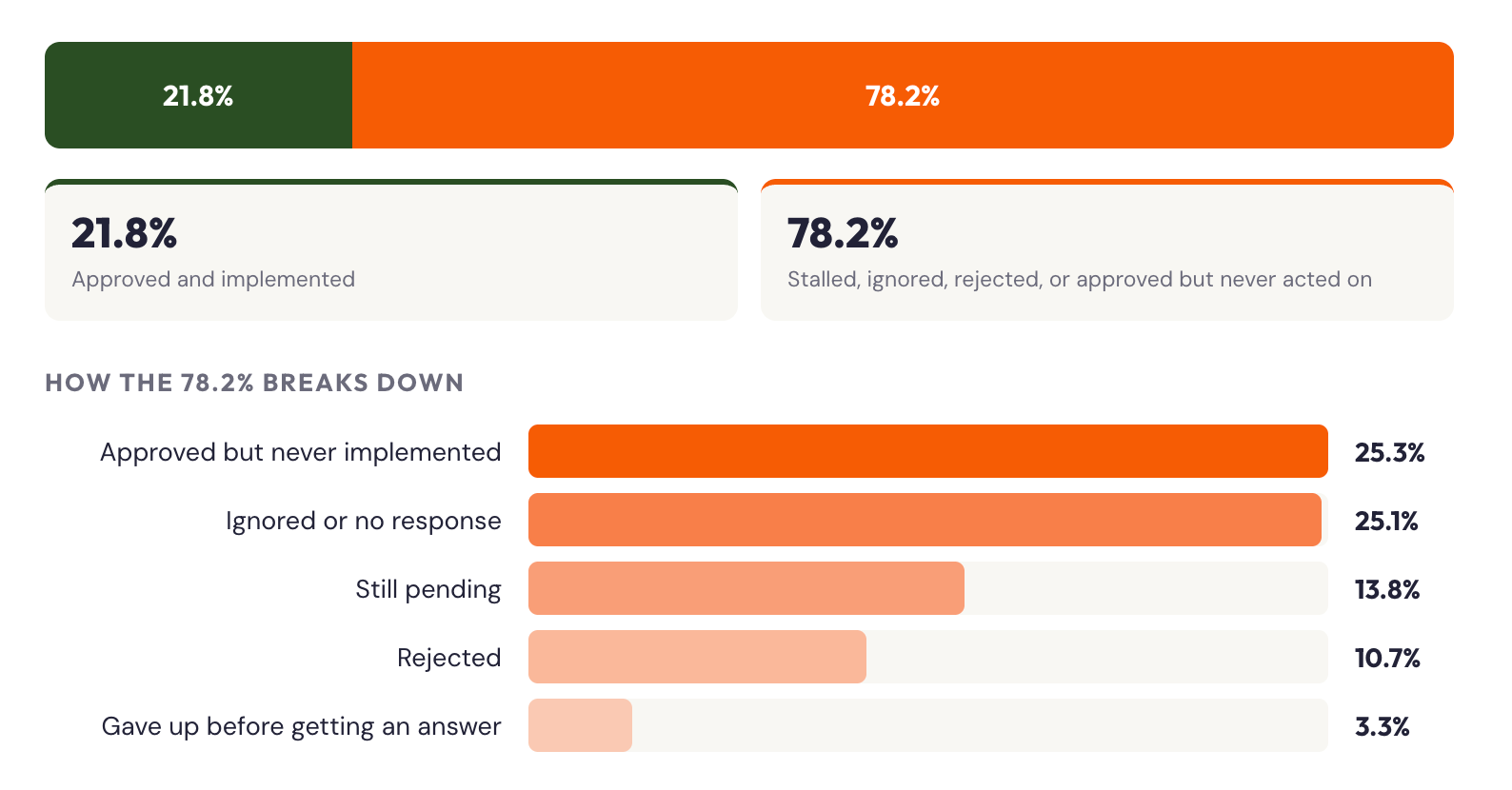
The single most common outcome for an educator's proposal is approval followed by inaction.
One in four ideas that cleared every hurdle and received official approval were never put into practice. And at virtually the same rate, one in four proposals were simply ignored, receiving no formal response at all.
These two categories, empty approval and outright neglect, account for more than half of all outcomes combined.
The system fails through both mechanisms at nearly identical rates, which suggests that the problem is deeply structural. If the dominant form of rejection were an explicit "no," that would at least imply a functioning decision-making process. Instead, the most common experience is silence or a yes that leads nowhere.
Only 10.7% of proposals were formally rejected. Educators are far more likely to receive no answer than a negative one.
Among educators in administrative roles, people who run schools and districts and presumably understand how proposals move through the system, only 18.0% of their most recent proposals were approved and implemented.
That is the lowest implementation rate of any subgroup in the data. Administrators propose more often than any other group (67.8% have done so), and their proposals reach higher levels of the hierarchy (31.2% reach district-level administration, compared to 10.9% for teachers).
But more proposals traveling further through the bureaucracy does not translate into better results.
70.5% of Proposals Never Get Past the Principal
When educators were asked to identify the highest level their proposal reached, the responses reveal a clear chokepoint.
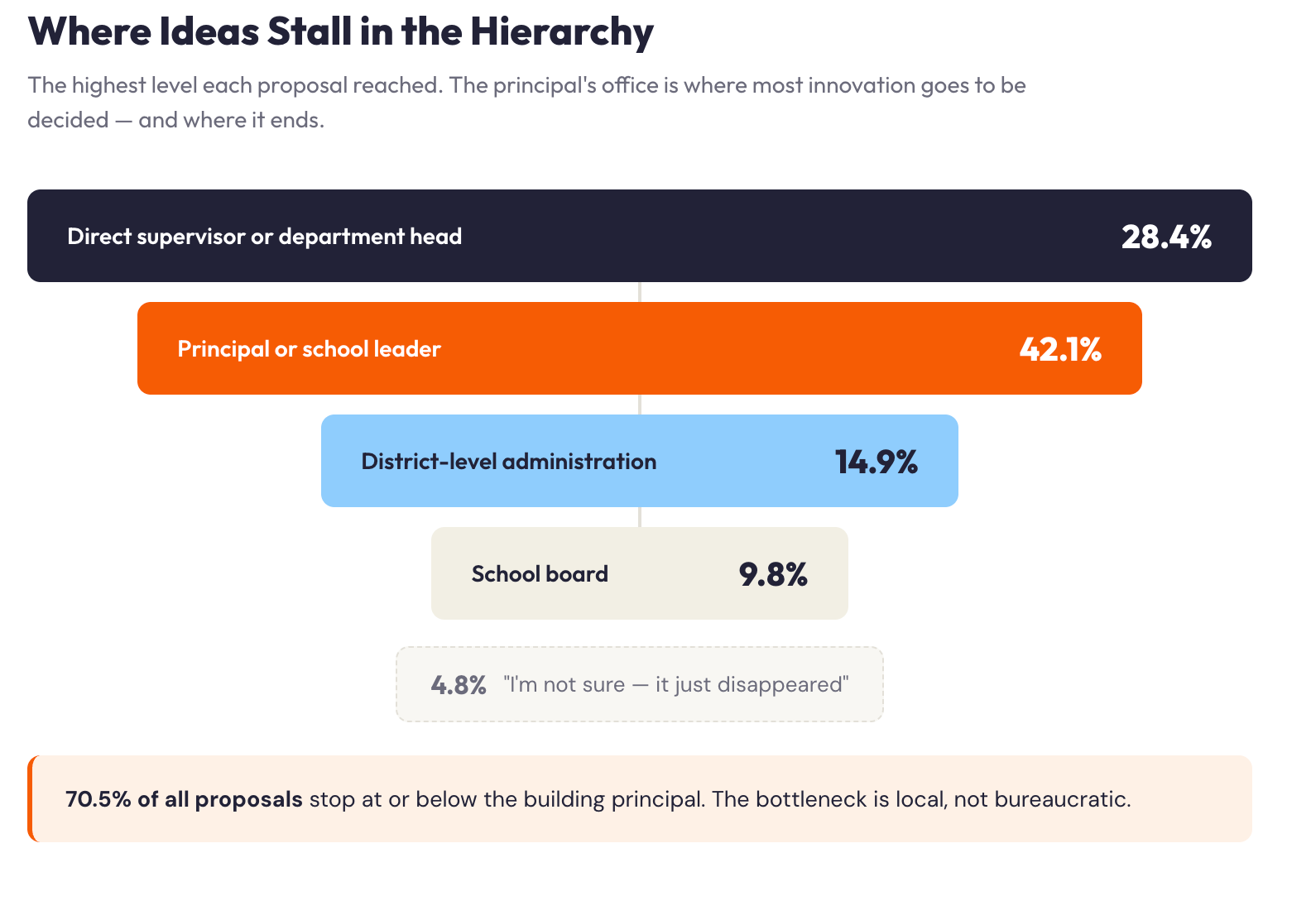
More than 70% of all proposals stop at or below the building principal. The principal's office is where the vast majority of educator innovation goes to be decided, and for most proposals, it is where the process ends.
This finding has practical implications for anyone trying to support educator-led innovation. The bottleneck is local, concentrated at the school building level rather than in district offices or school boards.
For teachers specifically, the concentration is even more dramatic: 76.0% of teacher proposals never get past the principal, with 53.9% stalling at the principal and 22.2% stopping at the department head.
The pattern shifts for administrators, whose proposals travel further by default. Only 47.5% of admin proposals stop at the principal level, while 31.2% reach district administration and 14.8% reach the school board.
But reaching higher levels does not improve outcomes. In fact, administrators have the lowest implementation rate in the entire dataset, which suggests that the problem is not about how far an idea travels but about what happens to it wherever it lands.
There is a modest structural advantage in private school settings.
Private school proposals reach direct supervisors at a higher rate (38.5% vs. 26.4% in public schools), consistent with flatter organizational hierarchies, and are implemented at 28.2% compared to 22.1% in public schools. The difference is real but limited: even in private schools, the majority of proposals fail.
22.5% of Educators Who Proposed Are Now Less Likely to Try Again
The consequences of this process extend beyond individual proposals. They shape whether educators are willing to engage the system at all in the future.
Among the 458 educators who have formally proposed an idea, the experience left them in one of several places:

A slim majority, 51.1%, say the experience made them more likely to try again. But 22.5%, more than one in five, came out of the process less willing to propose ideas in the future. And 2.8% say they will probably never propose an idea again.
The chilling effect is not distributed evenly. It deepens with experience. Among veteran educators with 15 or more years in the field, 28.6% say they are less likely or will never propose again, and 4.3% fall into the "never again" category. These are the educators with the deepest knowledge of curriculum, student needs, and institutional dynamics, and the system's response to their ideas has taught a meaningful share of them to stop offering.
Early-career educators show more resilience, with 61.0% saying the experience made them more likely to try again. But their proposals also have the lowest implementation rate of any experience group at just 16.4%, compared to 24.9% for veterans.
The system rewards tenure rather than initiative, and the youngest educators - the ones most likely to bounce back - are also the ones whose ideas are least likely to be acted on.
What This Means for Education Innovation
The formal process for educator-led innovation inside schools and districts produces a consistent result: the vast majority of ideas either stall, disappear, or receive approval that never translates into action.
This pattern holds across roles, experience levels, school types, and demographics. It is not a story about any particular group's ideas being unworthy. It is a story about a process that does not function.
The system's response to its own innovators creates a compounding problem - when the most likely outcome of proposing an idea is silence or empty approval, and when more than one in five educators who go through the process emerge less willing to try again, the pipeline does not just fail to implement ideas.
It actively trains people to stop offering them.
The educators with the most institutional knowledge and the deepest understanding of what students need are the ones most likely to have learned, through repeated experience, that proposing ideas is not worth the effort.
This has implications beyond any individual school or district. A system that cannot process the ideas of the people closest to its core work will consistently underperform, regardless of how much external innovation is brought to bear.
The bottleneck is specific, concentrated at the building level, and the failure mode is consistent: not outright rejection, but indifference and inaction.
The ideas exist. The willingness to propose them exists, at least initially.
What does not exist is a system that responds to either one in a way that produces results.
Methodology: This report is based on a survey of 1,000 educators in the US. Respondents include classroom teachers, administrators, instructional coaches, counselors, and other education professionals across public, private, and charter school settings. The survey captured educators across all experience levels, with a median of approximately 13 years in the field.
Be part of the community