Education Innovation Survey: Atlanta
What Atlanta Educators Say About Innovation and the System Around Them
.png)
Atlanta's educators are not short on nerve. Asked why their ideas never moved forward, not a single one pointed to fear of failure.
They pointed outward to money, to know-how, and to a leadership layer too distant and too transient to say yes.
This survey set out to measure something rarely quantified: how many people inside the education system have ideas for new schools, programs, tools, or learning models and what happens when they try to act on them.
Survey data shows that the will to innovate is widespread in Atlanta and the appetite for risk is intact.
What is missing is the scaffolding around the idea.
At a Glance
- 62.7% of Atlanta educators have had an idea for a new school, program, tool, or app.
- 70.2% of those educators never pursued their idea.
- 0% said fear of failure was the reason an idea stalled.
- 86.4% of the reasons ideas didn't move forward are structural.
- 72.3% have considered leaving education to pursue their idea outside the system.
- 86.0% spent their own money on classroom tools, tech, or resources in the past year.
- 90.0% feel local decision-makers are distanced or disconnected from classroom reality.
- 72.7% would extend their time in education if given an environment to pilot new ideas.
Atlanta Educators Are Generating Ideas And Are Willing to Act
The starting point isn't a shortage of imagination.
62.7% of Atlanta educators have had an idea for a new school, program, teaching tool, or app at some point in their career.
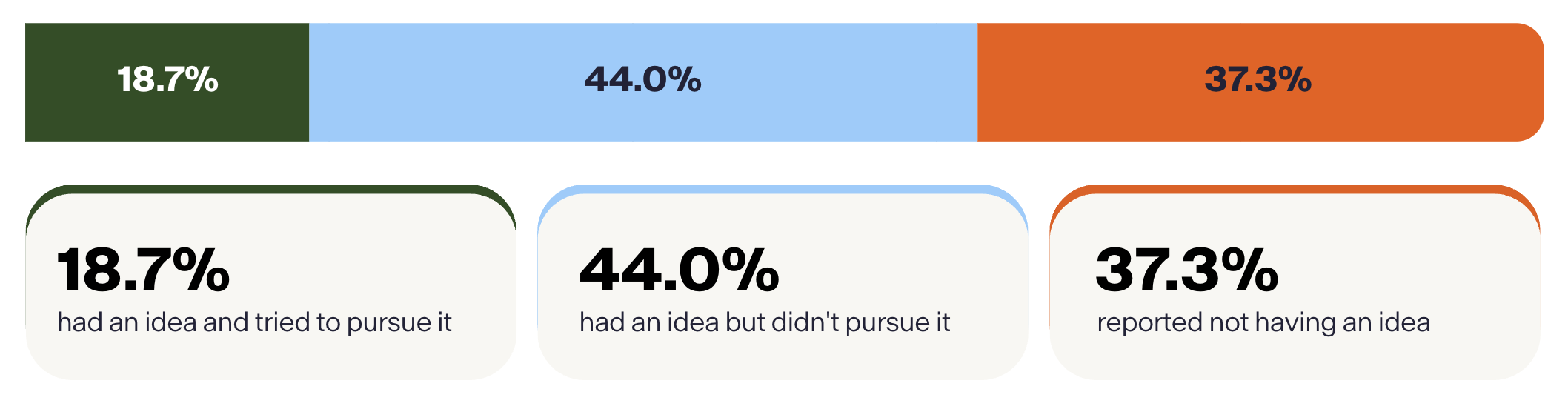
But most never act on it.
- 18.7% had an idea and tried to pursue it
- 44.0% had an idea but didn't pursue it
- 37.3% reported not having an idea
The same pull shows up in retention behavior. Among educators who have had an idea, 72.3% have seriously considered leaving education to pursue an opportunity outside the traditional school system:
- 13.8% have left or plan to leave,
- 58.5% considered it but decided to stay.
- 27.7% have never considered it.
The single largest group is made up of educators who felt the pull, weighed it, and chose to remain.
When asked what they would do with five extra hours and resources, educators split between deepening their own craft and reaching outward.
The top two responses ran nearly even: designing a new interdisciplinary curriculum (26.0%) and building partnerships with local businesses or mentors (25.3%).
Shadowing other innovative schools or classrooms followed at 19.3%, with prototyping a new student-facing app or tool at 15.3% and drafting a formal proposal for a new school model at 11.3%.
Nearly half - 44.7% combined - would use found time to connect outward (partnerships and shadowing) rather than build alone.
The appetite to connect is almost as strong as the appetite to create, and both point to educators who want to act, not just imagine.
The Barriers Are Mostly External
For educators who had an idea but didn't pursue it, the barriers reported were overwhelmingly informational and financial, not personal.
- 42.4% said: "I don't know how to start or where to go for help"
- 27.3% said: "I can't afford the financial risk"
- 16.7% said: "I don't think anyone would fund or support it"
- 12.1% said: "I don't have time outside my job"
- 1.5% said: "I don't want to leave my current students or school"
- 0.0% said: "I'm afraid it would fail"
The top three reasons - all structural in nature - together account for 86.4% of why ideas stall.
The headline is the number that isn't there: not one educator cited fear of failure as the reason their idea never moved.
Asked at the city level to identify the single biggest barrier preventing them from successfully launching new educational ideas, funding rises to the top:
- 30.7% funding - lack of local investors, grants, or philanthropists
- 18.0% time - workload leaves zero margin for design
- 17.3% network - not knowing the right people
- 12.7% information - lack of "how-to" pathways for this specific city
- 8.7% permission - too many approval layers
- 8.7% safety - risk to job or reputation if a pilot fails
- 4.0% other
Capacity-related barriers - funding, time, network, and information - account for 78.7% of responses.
Cultural and political barriers (permission and safety) together account for 17.3%.
Read together, the data describes a block that is external and fixable.
At the individual level it is not knowing where to start; at the systemic level it is capital.
Neither is a problem of courage or desire - both are problems of infrastructure.
The Leadership Layer Is Remote & It Keeps Changing
Asked who has the most influence over whether a new idea actually reaches students, educators' answers concentrate at the top:

Official top-down channels - superintendent, board, state, and principals - account for 86.7% of perceived influence, with the district top alone (superintendent and board) at 61.3%.
Grassroots actors (parents and philanthropy) sit at 8% combined.
And that layer feels far away. Only 10.0% of educators describe local decision-makers as "close - they visit often and understand the daily struggle."
57.3% say "distanced - they mean well but are out of touch," and 32.7% say "disconnected - they live in a different reality entirely."
Taken together, 90.0% experience a gap between the people deciding and the classroom.
What sharpens the picture for Atlanta is what educators name as the city's single biggest local challenge. The top answer is not budgets or buildings - it is the people in charge:
- 28.7% inconsistent leadership or frequent turnover in administration
- 21.3% a risk-averse culture that fears negative media or parent pushback
- 15.3% excessive district-level reporting and red tape
- 14.0% outdated physical infrastructure
- 10.0% deeply siloed communication between schools or organizations
- 8.0% lack of safe or reliable student transportation
- 2.7% other
The most-heard procedural phrase reinforces it: 12.0% say the line they hear most often is "We need to wait for District approval first."
The three data points compound. The seat with the most power over whether an idea reaches students is the one educators experience as most distant - and the one they say turns over most.
Authority is concentrated where contact is thinnest and continuity is weakest.
Innovation Runs Into a Compliance-First Culture
When asked which single regional barrier they would dismantle tomorrow, educators reached first for the culture of evaluation, not the mechanics of the system:
- 28.0% the compliance-first mindset of local evaluations
- 22.7% the rigid minutes-per-subject instructional requirements
- 19.3% the strict boundary lines between school districts
- 15.3% the lack of a centralized incubator or support hub for new ideas
- 14.7% the slow procurement process for new tools or technology
The compliance-first mindset and rigid instructional requirements - the two barriers most directly about how much room there is to deviate - together account for 50.7% of first choices.
That lands in daily practice as a limited room to try.
Asked to describe the psychological safety they have to experiment and fail at school:
- 10.7% "No safety - mistakes are documented or punished"
- 29.3% "Very little - I only try things I know will work"
- 45.3% "Moderate - I can experiment if my scores stay high"
- 8.0% "High - my leadership encourages failing forward"
- 6.7% "Total freedom - innovation is expected, even if it fails"
85.3% of educators operate with moderate or less psychological safety to fail.
Only 14.7% have leadership that actively encourages risk, and a 40.0% report very little or none, meaning they only try what they already know will work.
The most-heard cultural phrase fits the same mold: 25.3% say the line they hear most often is "We've always done it this way."
This is the finding that reframes the earlier point.
When asked what stopped their ideas, zero educators named fear of failure - and yet the thing they would most want to dismantle is the compliance-first evaluation culture, and most operate with little room to fail.
The caution in Atlanta's classrooms is not coming from educators. It is built into the system around them.
The Ecosystem Is Fragmented but the Assets Are Sitting Unused
Educators in Atlanta don't describe a connected community around them.

83.3% of educators are not part of any organized innovation community, and roughly one-third didn't know such a community could exist in their city.
Asked where they would actually go locally for collaborators or support, the most common answer is their own contacts: 32.7% point to their personal network and 24.0% say "nowhere - I don't believe there is a local place that supports grassroots education ideas."
A local university or research hub draws 27.3%, and a specific local incubator or non-profit 15.3%.
More than half fall back on themselves or on nothing.
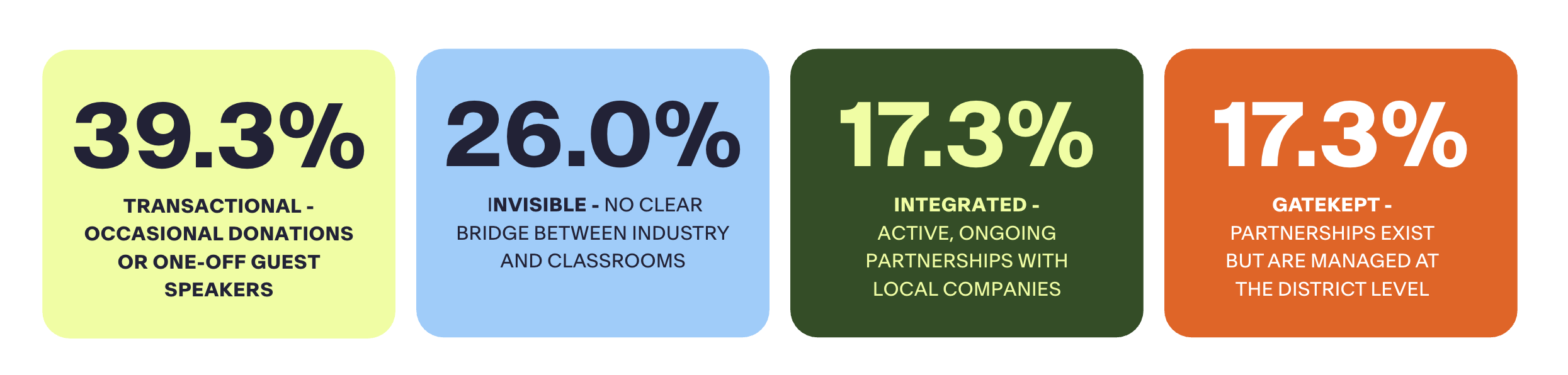
Industry ties tell a similar story. Asked to describe the connection between local industry and their school or organization:
- 39.3% transactional - occasional donations or one-off guest speakers
- 26.0% invisible - no clear bridge between industry and classrooms
- 17.3% integrated - active, ongoing partnerships with local companies
- 17.3% gatekept - partnerships exist but are managed at the district level
82.7% describe the industry–education connection as transactional, invisible, or gatekept..
At the same time, educators see significant untapped assets in the city. Asked what is the most under-leveraged asset in Atlanta, the top answers were:
- community-based organizations and non-profits (28.7%),
- local universities and research institutions (25.3%),
- local industry and corporate headquarters (16.0%),
- a strong spirit of local resilience and grassroots activism (11.3%),
- and the city's arts, music, and cultural scene (10.7%).
More than half of respondents - 54.0% combined - point to non-profits and universities as the biggest under-leveraged assets - the same institutions that could form connective infrastructure if mobilized.
The Cost Shows Up in Burnout, Spending, and a Stalled Climate
Asked what education issue local leaders are avoiding the most, educators name burnout first - by a wide margin.
- 39.3% the mental health and burnout of innovative educators
- 25.3% the widening gap between high- and low-performing local schools
- 22.0% student readiness for the local job market
- 6.0% AI completely replacing traditional testing
- 6.0% the need for radically different school models (microschools, pods)
- 1.3% other
Burnout leads, and the widening achievement gap follows close behind in second - an equity concern educators say is going unaddressed.
In the meantime, educators are subsidizing the system out of pocket.
86.0% of Atlanta educators spent their own money on tools, tech, apps, or resources in the past year.
Nearly a third - 31.3% - spent more than $300 of their own money in a single year.
Asked for the single word that best describes innovation in their city:
A majority - 54.7% - chose "stagnant" or "exhausted."
But the climate is not uniformly bleak: 35.3% chose "emergent" or "optimistic," describing pockets of greatness beginning to link up.
The energy to build something new is in short supply, but it has not run out.
Freedom to Pilot Is a Retention Strategy
If educators were to leave their current school in the next two years, the reason would be:
- 41.3% burnout - workload and red tape no longer sustainable
- 23.3% financial - need a higher salary
- 15.3% toxic culture - unsupportive leadership or environment
- 10.7% pursuit of an idea - to launch outside the system
- 4.7% lack of autonomy - no freedom to innovate
- 4.7% other (predominantly retirement)
The flip side is the lever.
Asked how their plans would change if they were guaranteed an environment where they could freely pilot new ideas:
- 46.0% "I would stay significantly longer than currently planned"
- 26.7% "I would stay a few years longer"
- 25.3% "It wouldn't change my current timeline"
- 2.0% "I am already planning to leave regardless"
72.7% of Atlanta educators would extend their time in education if given the freedom to pilot - and 46.0% would stay significantly longer.
The implication is direct: a structured pathway to experiment functions not only as an innovation strategy but as a retention one, addressing the same root cause - burnout and red tape - that drives most attrition in the first place.
What This Means
Atlanta's education workforce is full of ideas, and notably unafraid to act on them - asked what stopped them, not one educator pointed to fear of failure. The barriers are external and fixable: capital, clear pathways, connections, and room to try.
The layer with the most power over whether an idea reaches students is the one educators experience as most distant and most prone to turnover, inside a culture that rewards compliance over experimentation.
The community layer is thin. The cost is being absorbed by educators themselves, in cash and in burnout.
The same data points to the intervention. Educators want to connect outward as much as they want to build alone. They name non-profits and universities as the most under-leveraged assets in the city - the exact institutions that could form a connective ecosystem if mobilized. And nearly three-quarters say they would stay in education longer if given a structured way to pilot.
In Atlanta, building the conditions to experiment is not only how new ideas get built. It is how the people who have them are kept.
.png)
.png)
.png)
.png)
Be part of the community