Education Innovation Survey: Chicago
What Chicago Educators Say About Education, Morale, and the Room to Try Something New
.png)
Ask a Chicago educator what they hear most often at work, and one answer drowns out the rest.
Nearly half say the line that defines their workplace is some version of "we don't have the budget for that."
It is the city's reflexive response to a new idea, and nothing else comes close. When educators name the single biggest barrier to launching something new, funding sits at the top of the list.
But the survey complicates that story almost immediately. When the same educators describe why they might actually walk away from the profession, money is not the headline.
Burnout, culture, and the absence of any room to fail all outrank it. The system says no because of the budget. What it is quietly losing people over is something else.
This survey set out to measure how many people inside the education system carry ideas for new schools, programs, tools, or learning models, and what happens when they try to act on them.
At a Glance
- 64.0% of Chicago educators have had an idea for a new school, program, tool, or app. 70.8% of them never seriously pursued it.
- 76.5% of the reasons those ideas stalled are structural, not personal.
- 48.7% say the phrase they hear most at work is "we don't have the budget for that" — more than the next two phrases combined.
- 88.0% operate with moderate or less psychological safety to fail. Only 12.0% have leadership that encourages risk.
- 66.0% of likely departures trace to burnout, toxic culture, or lost autonomy — nearly three times the share who would leave over pay.
- 80.7% spent their own money on classroom tools, tech, or resources in the past year.
- 87.3% are not part of any organized innovation community.
- 68.0% would stay in education longer if given the freedom to pilot new ideas.
The Ideas Are There. The Follow-Through Isn't.
Imagination is not the bottleneck. 64.0% of Chicago educators have had an idea for a new school, program, teaching tool, or app at some point in their career.
Most of those ideas never leave the drawing board.

Among the educators who have had an idea, 70.8% never seriously pursued it. That gap between having a thought and acting on it is the central fact of this survey, and the rest of the report is largely an account of what fills it.
The same restlessness surfaces in how educators think about staying. Among those who have had an idea, 69.8% have seriously considered leaving education to chase an opportunity outside the traditional system.
Nearly a quarter (24.0%) have already left or plan to. Another 45.8% weighed it and decided to stay. Only 30.2% never considered it at all. The largest single group, then, is made up of people who felt the pull, thought it through, and remained.
Given five extra hours and the resources to use them, educators don't reach for solo invention so much as for connection.
The top three answers land within three points of each other: designing a new interdisciplinary curriculum (26.7%), building partnerships with local businesses or mentors (25.3%), and shadowing other innovative schools or classrooms (24.0%). Drafting a formal proposal for a new school model (14.0%) and prototyping a student-facing app (7.3%) trail well behind.
Put the two outward-facing options together and 49.3% would spend found time linking up with people and places beyond their own building rather than building alone.
The instinct is to plug in, not to retreat.
At the Desk, the Problem Is "How." In the Building, It's "Money."
The barriers educators name shift depending on the altitude of the question, and that shift is revealing.
Asked individually why their own idea stalled, educators who had one but didn't pursue it point first to a missing map, then to risk:

The top three reasons are all about pathways and backing rather than nerve, and together they account for 76.5% of why ideas stall.
Raise the question to the level of the city, and the answer changes shape. Asked for the single biggest barrier to launching new ideas locally, educators put capital first:
- 28.0% funding — lack of local investors, grants, or philanthropists
- 18.0% time — workload leaves no margin for design
- 16.7% network — not knowing the right people
- 12.7% safety — risk to job or reputation if a pilot fails
- 10.0% information — no clear "how-to" pathways for this city
- 9.3% permission — too many approval layers
Capacity-related barriers (funding, time, network, and information) make up 72.7% of responses, while cultural and political ones (permission and safety) account for 22.0%.
One detail breaks the pattern of the other answers: Chicago educators rank "safety," the risk of losing a job or reputation over a failed pilot, fourth, ahead of both information and permission.
That is higher than the personal-level fear numbers alone would predict, and it is the first hint that the climate around experimentation deserves a closer look.
The Default Answer Is "No," and It Carries a Dollar Sign
If one finding defines Chicago, it is the sound of the word no. Asked which phrase they hear most often in their local school culture, educators return an overwhelming verdict:
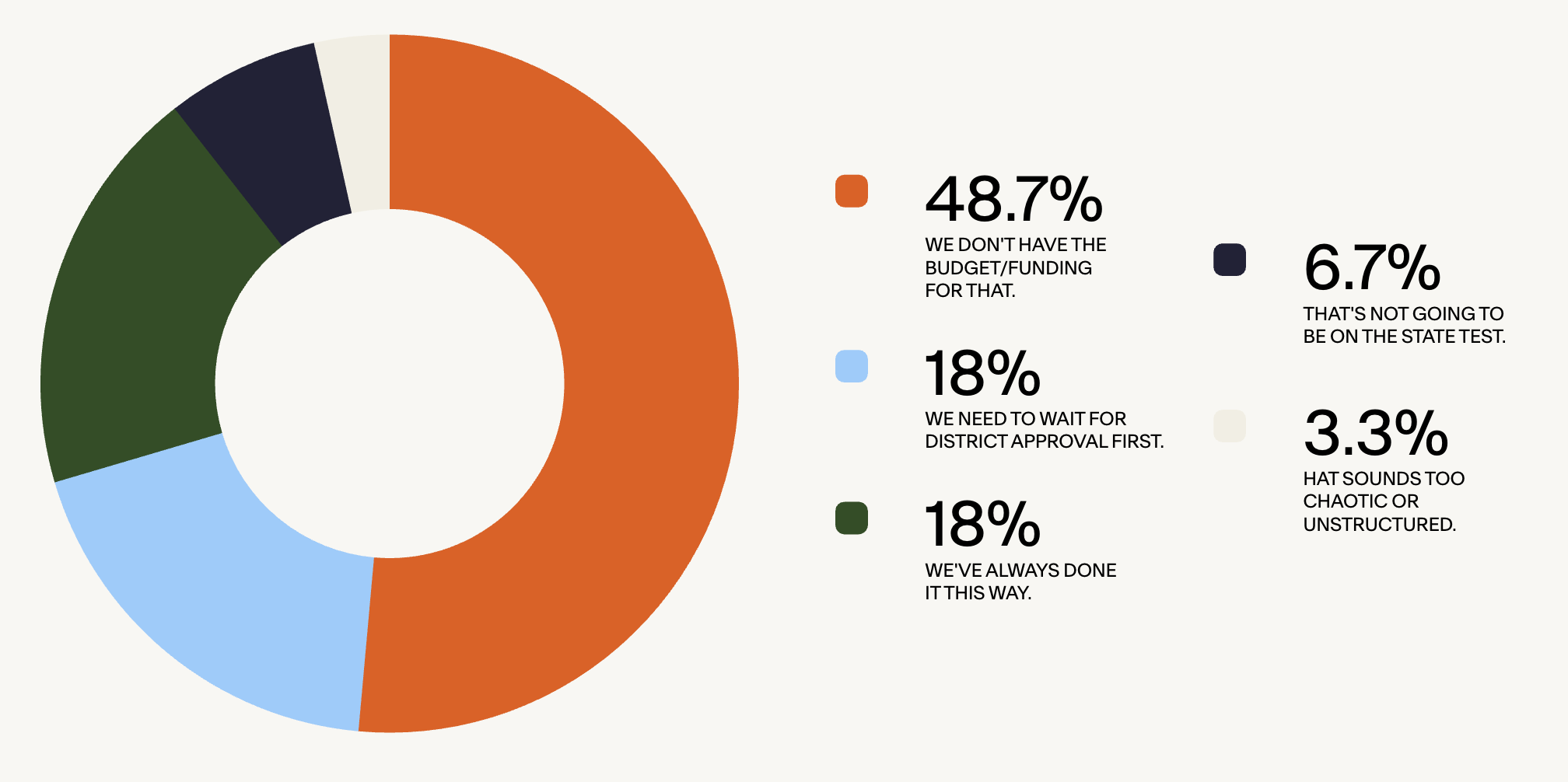
Roughly 95% of educators name some flavor of refusal as the dominant message in their workplace, and the budget version alone is louder than the approval and tradition answers put together.
Before an idea is judged on its merits, it meets a number.
The people with the power to overrule that number are, in educators' eyes, both concentrated and remote. Asked who has the most influence over whether a new idea actually reaches students:
- 27.3% the District Superintendent / Central Office
- 26.0% the Local School Board
- 18.7% state-level legislators
- 10.7% the Teachers' Union
- 8.0% individual school principals
- 5.3% parents and community advocacy groups
- 2.7% local philanthropic foundations or donors
Official top-down channels (superintendent, board, state, and principals) hold 80.0% of perceived influence.
What stands out in Chicago is that the superintendent and the school board sit almost exactly level with each other, 27.3% against 26.0%, rather than one office dominating. Grassroots actors, parents and philanthropy combined, register just 8.0%.
And that authority feels far from the classroom. Only 10.7% of educators describe local decision-makers as close enough to understand the daily struggle. 89.3% place them at a distance, split between 59.3% who call them "distanced — well-meaning but out of touch" and 30.0% who call them "disconnected — living in a different reality entirely."
The weight falls on distance rather than total detachment: educators are more inclined to say the people in charge mean well and have lost the thread than to write them off completely. The picture is of decision-making that pools at the top, keeps its distance, and hands down a budget refusal as its most frequent reply.
But Money Isn't What's Breaking the System
Here the survey turns on itself. The system frames its no as financial, yet the deeper measurements of why educators pull back and head for the exits point somewhere other than the checkbook.
Start with how safe it feels to try. Asked to rate the psychological safety they have to fail while testing a new method:
- 7.3% "No safety — mistakes are documented or punished"
- 34.0% "Very little — I only try things I know will work"
- 46.7% "Moderate — I can experiment if my scores stay high"
- 9.3% "High — my leadership encourages failing forward"
- 2.7% "Total freedom — innovation is expected, even if it fails"
88.0% of Chicago educators operate with moderate or less room to fail, the narrowest margin of any city in this series. Only 12.0% work under leadership that actively encourages risk. And 41.3% report little or no safety at all, including the 34.0% who say they will only attempt what they already know will succeed.
The 8.8% who privately admitted a fear of failure earlier are not outliers; they are reporting from inside a system that documents mistakes and rewards the safe bet.
That climate shows up again when educators imagine leaving. Asked the most likely reason they would exit their school within two years:
- 36.7% burnout — workload and red tape no longer sustainable
- 23.3% financial — need a higher salary
- 22.7% toxic culture — unsupportive leadership or environment
- 7.3% pursuit of an idea — to launch outside the system
- 6.7% lack of autonomy — no freedom to innovate
System-driven reasons (burnout, toxic culture, and lost autonomy) account for 66.0% of likely departures, nearly three times the share who would leave over pay. Most striking is that toxic culture (22.7%) sits essentially tied with salary (23.3%), which means an unsupportive environment pushes Chicago educators toward the door about as hard as their paycheck does.
This is the contradiction at the heart of the city's data. The reason offered for saying no is money. The reasons people give for leaving are mostly not.
The structural irritants reinforce the same theme. Asked to name the single biggest local challenge specific to Chicago, educators lead with the people in charge and the culture they set:
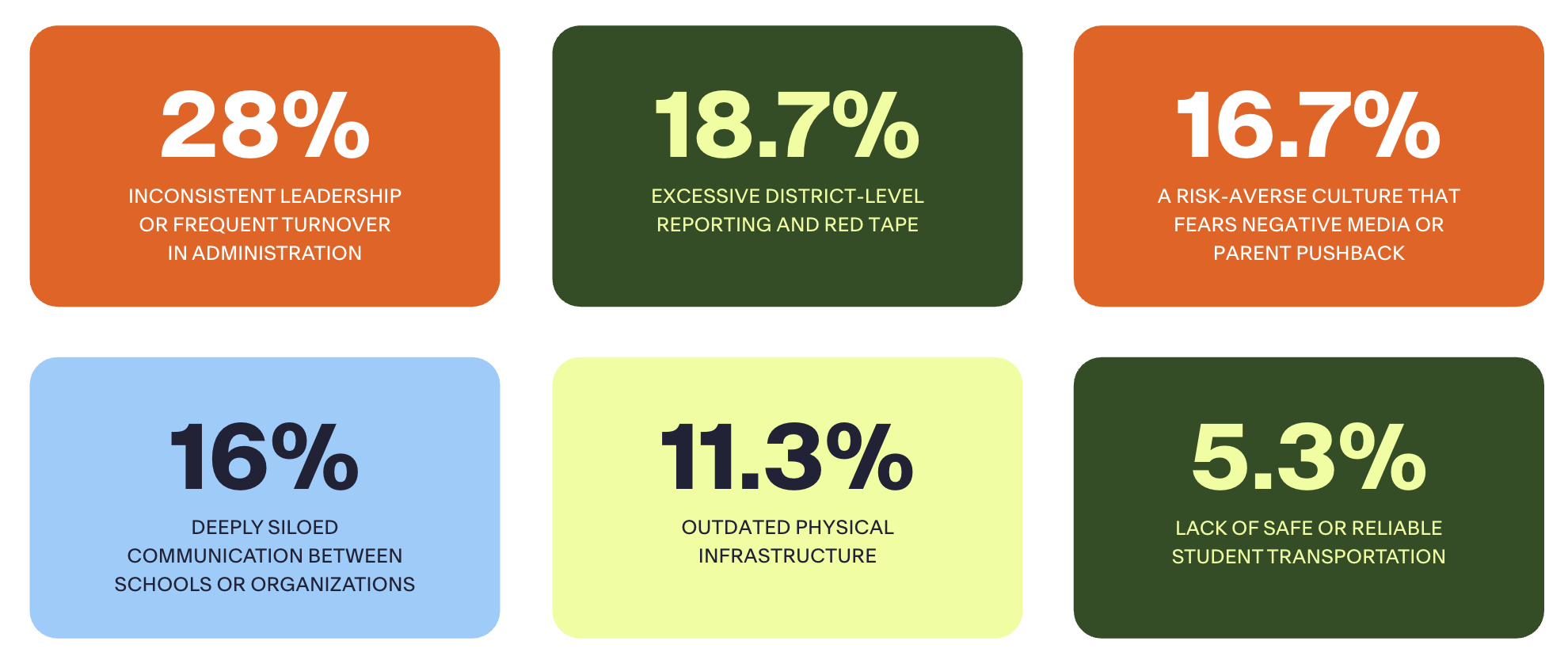
And when asked which regional barrier they would tear down tomorrow, Chicago refuses to name a single villain. Three answers finish in a near dead heat:
- 23.3% the strict boundary lines between school districts
- 23.3% the compliance-first mindset of local evaluations
- 22.7% the rigid minutes-per-subject instructional requirements
- 16.7% the lack of a centralized incubator or support hub
- 14.0% the slow procurement process for new tools
The compliance-first mindset and the rigid instructional clock, the two barriers most about how much latitude a teacher has to deviate, together draw 46.0%. But the answer that distinguishes Chicago from other cities is the one tied for first: nearly a quarter would dismantle the hard boundary lines between districts. In a metro carved into a patchwork of separate systems, fragmentation registers as a structural barrier in its own right, not just a map.
There's No Ecosystem to Catch an Idea
Even an educator who clears the budget refusal and the safety question lands somewhere with no net beneath it.
Asked to describe the innovation community around them:
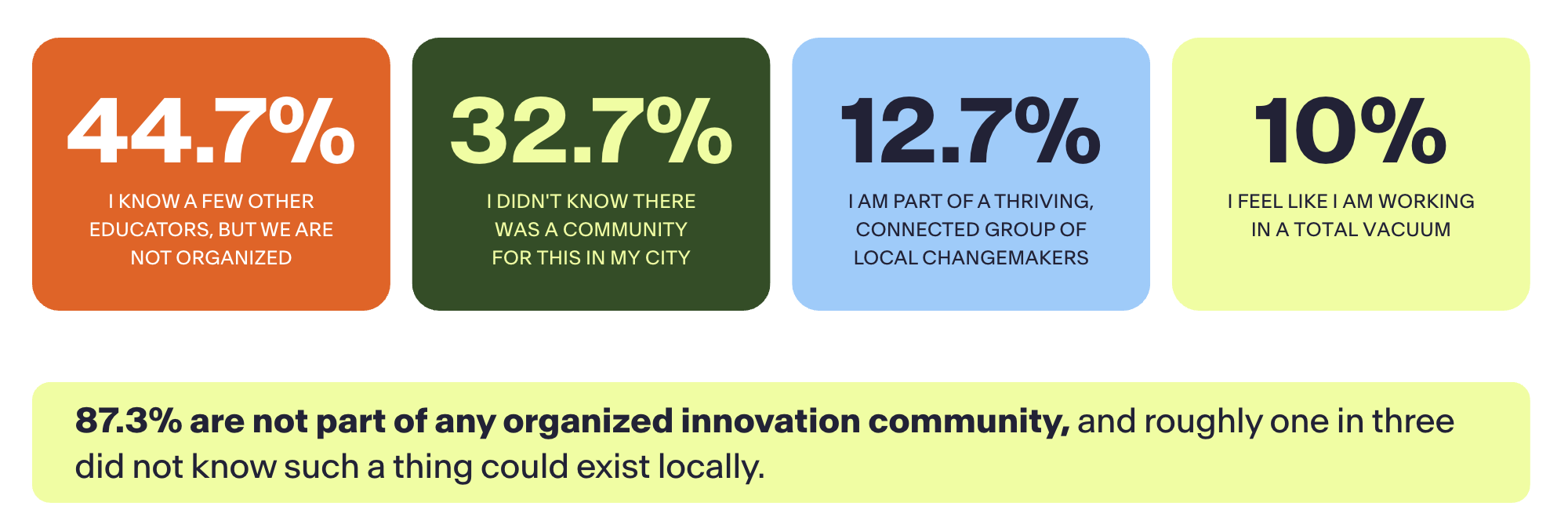
When the connective tissue is missing, support gets privatized.
Asked where they would actually go for collaborators, the most common answer is their own contacts:
- 33.3% my own personal network
- 26.0% a local university or research hub
- 24.7% nowhere — I don't believe a local place exists for grassroots education ideas
- 14.7% a specific local incubator or non-profit
The leading resource is the educator's personal rolodex, and nearly a quarter believe there is simply nowhere to turn. Industry offers little more.
Asked to characterize the link between local industry and their school:
- 36.7% transactional — occasional donations or one-off guest speakers
- 34.7% invisible — no clear bridge between industry and classrooms
- 16.0% gatekept — partnerships exist but are managed at the district level
- 12.7% integrated — active, ongoing partnerships with local companies
87.3% describe the industry connection as transactional, invisible, or gatekept, and only one in eight reports a real partnership.
The frustrating part is that educators can see the resources going unused. Asked to name the city's most under-leveraged asset:
- 26.7% local universities and research institutions
- 23.3% community-based organizations and non-profits
- 16.0% the city's arts, music, and cultural scene
- 15.3% local industry and corporate headquarters
- 10.7% the city's geographic layout
- 8.0% a strong spirit of local resilience and grassroots activism
Exactly half of respondents point to universities and non-profits as the biggest wasted assets, which is to say the very institutions that could function as connective infrastructure if anyone organized them to. The pieces of an ecosystem are present. Nothing is assembling them.
The Cost, and the One Lever That Fits It
The bill for all of this comes due in predictable places. Asked which issue local leaders are most avoiding, educators name the human one first:
- 38.7% the mental health and burnout of innovative educators
- 22.7% the widening gap between high- and low-performing schools
- 13.3% the need for radically different school models
- 12.7% student readiness for the local job market
- 8.7% AI replacing traditional testing
Burnout leads by a wide margin, the same burnout that tops the list of reasons people leave. In the meantime, educators are covering the system's shortfalls themselves. 80.7% spent their own money on tools, tech, or resources in the past year, and 28.0% spent more than $300 out of pocket in a single year.
The budget that supposedly isn't there is, in part, being supplied quietly by teachers.
Asked for one word to describe innovation in their city, a clear majority chose a tired one:
- 32.0% stagnant — the system is actively resisting new ideas
- 28.7% exhausted — people want to innovate but have no energy left
- 21.3% emergent — small pockets of greatness are starting to connect
- 9.3% restless — ready for change but stuck
- 8.7% optimistic — we are the next great hub for education design
60.7% chose "stagnant" or "exhausted," and fewer than one in ten chose "optimistic." Yet 30.0% reached for "emergent" or "optimistic," which means the embers are not entirely out.
This is where the survey's central mismatch becomes a recommendation. If educators were mostly leaving over pay, the fix would be a raise. They are not. They are leaving over burnout, culture, and the absence of room to try. So the intervention that matches the diagnosis is not a larger paycheck but a different set of conditions. Asked how a guaranteed environment to freely pilot new ideas would change their plans:
- 44.0% "I would stay significantly longer than currently planned"
- 24.0% "I would stay a few years longer"
- 28.0% "It wouldn't change my current timeline"
- 2.0% "I am already planning to leave regardless"
68.0% would extend their time in education if given the freedom to pilot, and 44.0% would stay significantly longer — the single largest response to any question on the survey.
A structured pathway to experiment lands directly on the burnout and red tape that drive most attrition. It is an innovation strategy and a retention strategy at once, because in Chicago they turn out to be the same strategy.
What This Means
Chicago's educators are not waiting to be inspired. Two-thirds carry ideas, half want to spend their spare hours connecting outward, and the largest group among them have already considered leaving and chosen, for now, to stay. The thing standing between the idea and the attempt is not courage. It is a wall of money said out loud, a layer of decision-makers who feel distant and turn over often, a workplace where failure is rarely safe, and a city with no organized place to bring a new idea.
The most repeated phrase in Chicago's schools is "we don't have the budget." It is the cheapest possible answer, and the survey suggests it is also a misdiagnosis. The deeper account in the data is about climate: the narrowest room to fail of any city surveyed, a toxic culture nearly tied with pay as a reason to leave, and a connective ecosystem that exists only as scattered, unmobilized parts.
That same data points to the way out. Educators name universities and non-profits as the city's most wasted assets, the exact institutions that could knit the scattered parts into something durable. And more than two-thirds say a real chance to pilot would keep them in the profession longer.
In Chicago, the easiest thing to say is that there isn't enough money. The harder and more accurate thing the data asks leaders to confront is that money was never the only thing missing.
.png)
.png)
.png)
.png)
Be part of the community