Education Innovation Survey: Miami
What Miami Educators Say About Education, Innovation, and the System Around Them
.png)
In most accounts of why teachers leave the profession, burnout is the headline. In Miami it runs second.
Asked why they might walk away from their school within the next two years, the largest group of educators did not point to exhaustion or red tape. They pointed to the cost of living.
The most common reason Miami educators would leave is financial: they cannot afford to stay in the city on what the job pays.
That pressure does not stay inside the paycheck. It surfaces at nearly every level of this survey. Money is tied for the top reason educators never chased an idea. It is the single biggest barrier they name to launching anything new locally.
And the phrase they hear most often at work, by a wide margin, is some version of "we don't have the budget for that."
This survey set out to measure how many people inside the education system carry ideas for new schools, programs, tools, or learning models, and what happens when they try to act on them.
At a Glance
- 66.7% of Miami educators have had an idea for a new school, program, tool, or app. 71.0% of them never seriously pursued it.
- 84.5% of the reasons those ideas stalled are structural, with financial risk and "I don't know how to start" tied at the top, 35.2% each.
- Financial pressure is the single biggest reason Miami educators would leave their school (39.3%), ahead of burnout.
- 48.0% say the phrase they hear most at work is "we don't have the budget for that."
- 30.0% of educators who have had an idea have already left or plan to leave to pursue it. Another 49.0% considered it but stayed.
- 88.7% see local decision-makers as distanced or disconnected from classroom reality.
- 82.7% spent their own money on classroom tools, tech, or resources in the past year.
- 68.7% would extend their time in education if given the freedom to pilot new ideas.
The Ideas Exist But Most Never Move
Imagination is not in short supply. 66.7% of Miami educators have had an idea for a new school, program, teaching tool, or app at some point in their career.
Most of those ideas stay in the head that had them.

Nearly one in five educators has actually tried to act on an idea, which is not nothing. But among everyone who has had one, 71.0% never seriously pursued it. The distance between thinking of something and attempting it is the gap this report tries to explain.
That same restlessness shows up in how educators think about their careers. Among those who have had an idea, 79.0% have seriously considered leaving education to chase an opportunity outside the system. Thirty percent have already left or plan to, a strikingly large share. Another 49.0% weighed it and stayed.
Only 21.0% say the thought never crossed their mind.
Asked what they would do with five spare hours and the resources to use them, educators reach outward before they reach inward.
Building partnerships with local businesses or mentors tops the list at 28.7%. Designing a new interdisciplinary curriculum and shadowing other innovative schools tie behind it at 22.0% each.
Put the two outward-facing options together and 50.7% would spend found time connecting with people and places beyond their own building.
Another quarter would build something concrete: prototyping a student-facing app and drafting a formal school-model proposal each drew 13.3%. The instinct is to link up and to make, not to sit with the idea.
Money and Pathways: Two Equal Walls
For educators who had an idea but didn't pursue it, two barriers stand exactly level at the top:
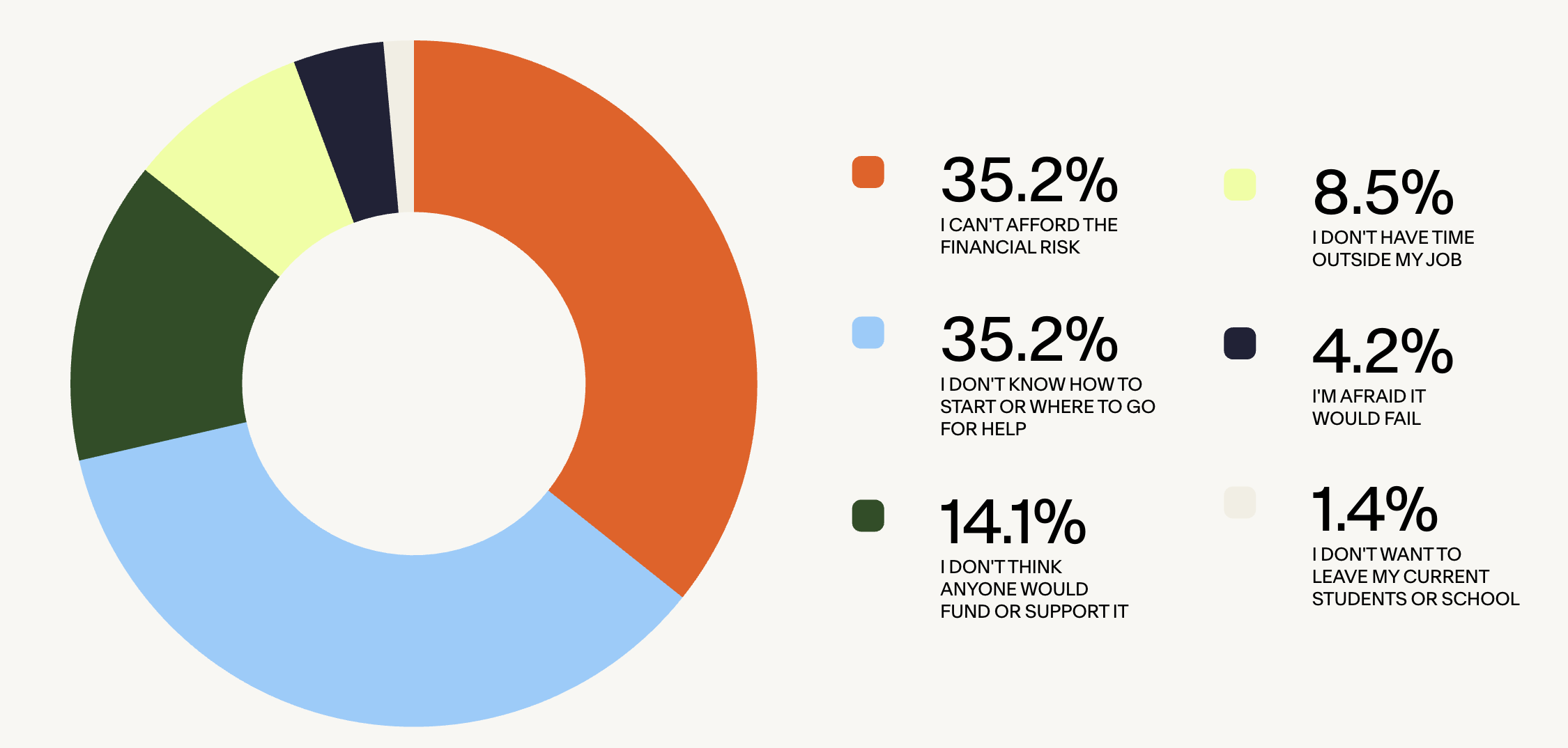
The top two are tied to the decimal, splitting the field evenly between a money problem and a map problem.
Together they account for 70.4% of responses, and once "I don't think anyone would fund it" is added, 84.5% of the reasons ideas stall come down to cost and pathways.
Fear of failure sits at just 4.2%. Whatever is stopping Miami's educators, it is not nerve.
Raise the question to the level of the city and the wall widens rather than narrows. Asked for the single biggest barrier to launching new ideas locally:
- 28.0% funding - lack of local investors, grants, or philanthropists
- 20.7% time - workload leaves no margin for design
- 20.0% network - not knowing the right people
- 10.7% information - no clear "how-to" pathways for this city
- 10.0% safety - risk to job or reputation if a pilot fails
- 8.0% permission - too many approval layers
Funding leads, but time and network press right behind it, with all three bunched between 20 and 28 percent. Capacity-related barriers (funding, time, network, and information) make up 79.3% of responses, while cultural and political ones account for just 18.0%. There is no single obstacle to remove. There is a thick band of them, and most are about resources rather than rules.
Power Sits With the Board, and Feels Far Away
Asked who holds the most influence over whether a new idea actually reaches students, Miami educators put an elected body first:
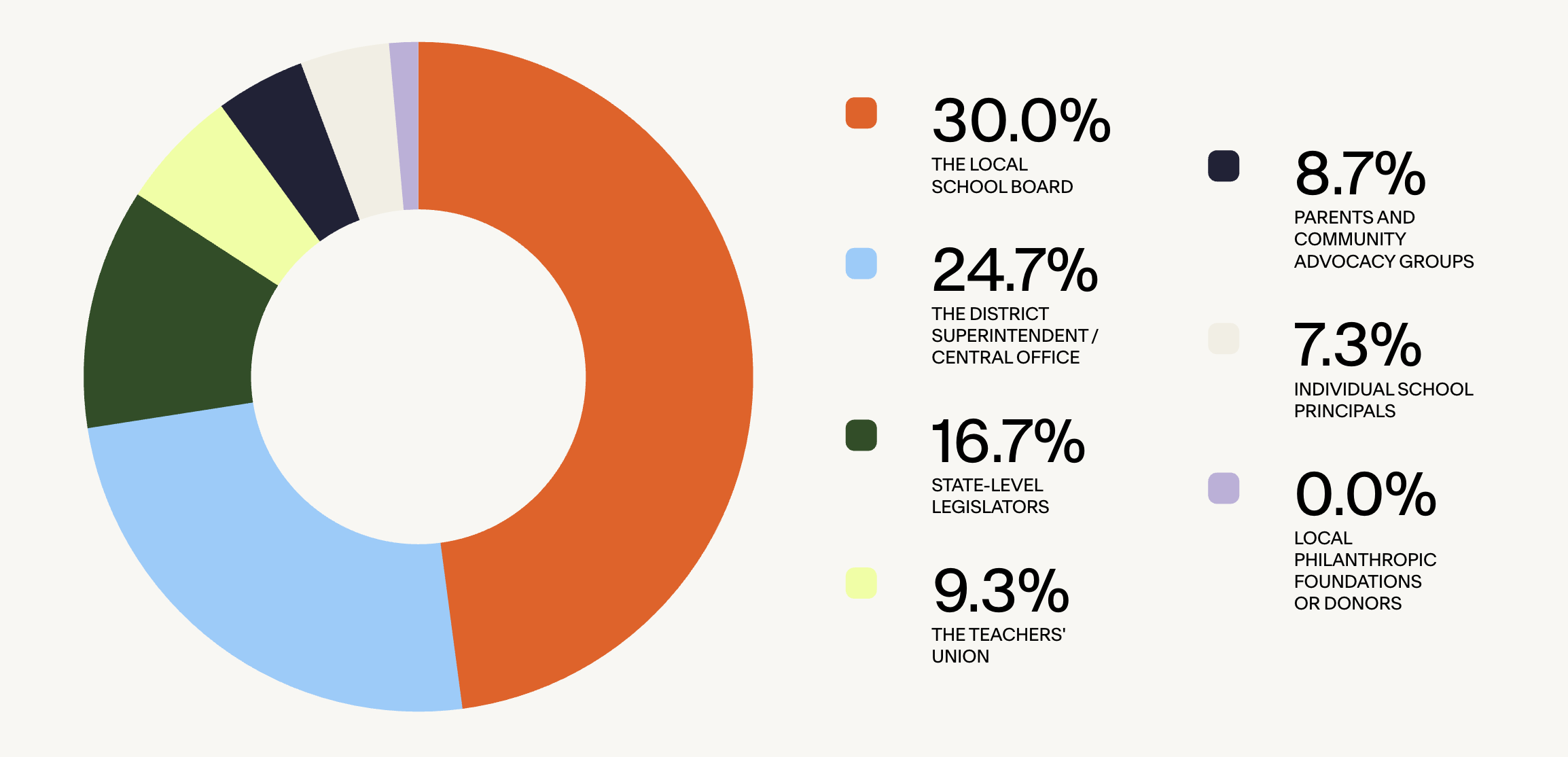
The school board leads the superintendent's office by more than five points, an unusual tilt toward the elected layer rather than the administrative one. Official top-down channels together hold 78.7% of perceived influence. And one option drew no votes at all: not a single educator named local philanthropic foundations as the most influential force over what reaches students. In a city where funding is the leading barrier, the people who write checks are seen as having no real say in what gets built.
Wherever the power sits, it feels distant. Only 11.3% of educators describe local decision-makers as close enough to understand the daily struggle. 88.7% place them at a remove, with 50.0% calling them "distanced, well-meaning but out of touch" and a notably high 38.7% calling them "disconnected, living in a different reality entirely." The gap here is not just a matter of polite distance. Nearly four in ten describe a leadership that has lost contact with the classroom completely.
The local challenges educators name reflect the same scattered quality seen in the barriers. Inconsistent leadership and turnover (22.0%), excessive reporting and red tape (21.3%), and deeply siloed communication between schools (18.0%) cluster within four points of one another, with no single dominant complaint. What does come through with one clear voice is the message educators hear coming down from above.
Asked which phrase they hear most often:
- 48.0% "We don't have the budget/funding for that."
- 18.0% "We've always done it this way."
- 16.7% "We need to wait for District approval first."
- 7.3% "That's not going to be on the state test."
- 4.0% "That sounds too chaotic or unstructured."
Some flavor of refusal is the dominant workplace phrase for 94.0% of educators, and the budget version alone is nearly half of all answers. A new idea meets a number before it meets a hearing.
No Single Place to Land
An educator who pushes past the money and the map still has nowhere obvious to take the idea. Asked to describe the innovation community around them:
- 38.7% "I know a few other educators, but we are not organized"
- 34.7% "I didn't know there was a community for this in my city"
- 14.7% "I feel like I am working in a total vacuum"
- 12.0% "I am part of a thriving, connected group of local changemakers"
88.0% are not part of any organized innovation community, and more than a third did not know one could exist locally. So when an idea needs collaborators, educators scatter in every direction at once:
- 27.3% a local university or research hub
- 26.7% nowhere - no local place exists for grassroots education ideas
- 23.3% my own personal network
- 22.7% a specific local incubator or non-profit
These four answers sit within 4.6 points of each other, which means there is no agreed-upon front door for a new idea in Miami. Most striking is the second-place finish: "nowhere" lands just 0.6 points behind universities, with more than a quarter of educators convinced there is no local place built to support grassroots education work at all.
Industry offers little to fill the gap. Asked to describe the connection between local industry and their school:
- 43.3% transactional - occasional donations or one-off guest speakers
- 34.7% invisible - no clear bridge between industry and classrooms
- 12.0% gatekept - partnerships managed at the district level
- 10.0% integrated - active, ongoing partnerships with local companies
90.0% describe the industry connection as transactional, invisible, or gatekept, and the most common pattern by far is the shallow one: a donation here, a guest speaker there, no depth behind it. Only one in ten reports a real partnership.
The frustration is that educators can name the assets going to waste. Community-based organizations and non-profits (26.0%) and local universities (22.0%) top the list of the city's most under-leveraged resources, together drawing 48.0%. The rest spreads thinly across arts and culture, industry, grassroots energy, and the city's geography, with no second tier emerging. The raw material for a connective ecosystem is here. Nothing is organizing it into one.
Strained, But Not Stalled
The toll of all this lands first on educators themselves. Asked which issue local leaders are most avoiding, they name the human one:
- 34.0% the mental health and burnout of innovative educators
- 21.3% student readiness for the local job market
- 19.3% the widening gap between high- and low-performing schools
- 19.3% AI completely replacing traditional testing
- 3.3% the need for radically different school models
Burnout leads, but a cluster of economic and future-facing worries sits close behind, with concern about AI displacing traditional testing pulling even with the achievement gap. In the meantime, educators are quietly footing the bill. 82.7% spent their own money on tools, tech, or resources in the past year, and 15.3% spent more than $500, including 8.0% who spent over a thousand dollars out of their own pockets in a single year.
Room to experiment is thin. 84.7% of educators operate with moderate or less psychological safety to fail, and only 15.3% work under leadership that actively encourages risk. Two in five will only attempt what they already know will succeed.
And yet the mood is not one of defeat. Asked for one word to describe innovation in their city:
- 32.7% stagnant - the system is actively resisting new ideas
- 22.7% emergent - small pockets of greatness are starting to connect
- 21.3% exhausted - people want to innovate but have no energy left
- 16.7% restless - ready for change but feel stuck
- 6.7% optimistic - we are the next great hub for education design
Stagnant leads, as it often does in a strained system. But the second most common word is "emergent," edging out exhaustion, and together "emergent" and "restless" account for 39.3% of responses. That is a substantial share reporting either visible pockets of progress or a readiness to move. Miami reads as a place under real strain that has not gone quiet.
Retention Has Two Locks, and Pilot Freedom Opens One
The survey closes on the question that matters most to anyone trying to keep educators in the profession, and Miami's answer is unusually clear-eyed. Asked the most likely reason they would leave their school within two years:
- 39.3% financial - need a higher salary to live in this city
- 34.7% burnout - workload and red tape no longer sustainable
- 12.0% toxic culture - unsupportive leadership or environment
- 8.0% pursuit of an idea - to launch outside the system
- 4.7% lack of autonomy - no freedom to innovate
System-driven reasons (burnout, toxic culture, and lost autonomy) account for 51.3% of likely departures. But the single largest reason, by nearly five points, is the cost of living. In Miami, the question of whether educators stay is partly about the conditions of the work and partly about whether the math of living in the city works at all.
That distinction matters when weighing the fix. Asked how a guaranteed environment to freely pilot new ideas would change their plans:
- 34.7% "I would stay significantly longer than currently planned"
- 34.0% "I would stay a few years longer"
- 27.3% "It wouldn't change my current timeline"
- 4.0% "I am already planning to leave regardless"
68.7% of Miami educators would extend their time in education if given the freedom to pilot, with the two "stay longer" options running essentially even. That lever is real, and it points directly at the burnout, autonomy, and culture drivers that make up a slim majority of attrition.
It does not, however, reach the biggest driver of all. Freedom to pilot can give an exhausted educator a reason to stay, but it cannot raise a salary that no longer covers the rent. The 39.3% who would leave over cost of living sit outside that lever entirely.
In Miami, retention has two locks. A structured path to experiment opens one of them, and the other will need an answer of its own.
What This Means
Miami's educators are not waiting for inspiration. Two-thirds carry ideas, half would spend spare hours connecting outward, and nearly a third have already considered leaving to build something elsewhere. What stands between the idea and the attempt is not a failure of nerve. It is a wall of cost, a leadership layer that feels far from the room, and a city with no single place to bring a new idea and no organized community to join.
Money runs through all of it. It is the reason ideas stall, the default answer educators hear, and the most common reason they would leave the profession outright. The barriers and the resources are equally diffuse: no dominant obstacle to remove, no obvious front door to walk through, just a thick band of capacity problems and a scatter of underused assets that no one has connected.
The same data shows the way forward, and its limits. The city's non-profits and universities are named again and again as wasted potential, the exact institutions that could become connective tissue if anyone mobilized them. More than two-thirds of educators say a real chance to pilot would keep them longer, and the survey's undercurrent of "emergent" energy suggests the appetite is there to be met.
But the loudest signal in Miami is also the hardest to engineer around. A pathway to experiment will hold the educators who are burning out. It will not, on its own, hold the ones who simply can no longer afford to teach in the city they serve.
.png)
.png)
.png)
.png)
Be part of the community