Education Innovation Survey: San Antonio
What San Antonio Educators Say About Money, Burnout, and the System Around Them
.png)
Educators who sit on an idea usually point to a missing map. They say they don't know where to begin, who to ask, or where to go.
In San Antonio, the more common answer is blunter and harder to fix. They say they cannot afford the financial risk.
Money is the first wall here, named by the people who run into it rather than inferred from the system around them.
The twist is what those same educators are doing with their own money. They are spending it. A large share reached into their own pockets for classroom tools and resources this year, even while naming financial risk as the thing keeping their ideas on the shelf.
This survey set out to measure how many people inside the education system carry ideas for new schools, programs, tools, or learning models, and what happens when they try to act on them.
At a Glance
- 60.7% of San Antonio educators have had an idea for a new school, program, tool, or app. 78.0% of them never seriously pursued it.
- 84.5% of the reasons those ideas stalled are structural, not personal. Financial risk is the single biggest blocker at 39.4%.
- 86.0% spent their own money on classroom tools, tech, or resources in the past year. 45.3% spent more than $300.
- 94.0% say local decision-makers are out of touch or living in a different reality entirely. Only 6.0% feel they are close.
- 91.3% operate with moderate or less room to fail. Just 8.7% have leadership that encourages risk.
- 66.0% of likely departures trace to burnout, lost autonomy, or an unsupportive culture, more than twice the share who would leave over pay.
- 88.7% are not part of any organized innovation community.
- 68.7% would stay in education longer if given the freedom to pilot new ideas.
The Gap Between the Idea and the Attempt
The raw material is here, if a little thinner than the headlines suggest. 60.7% of San Antonio educators have had an idea for a new school, program, teaching tool, or app at some point in their career.
Far fewer act on it.
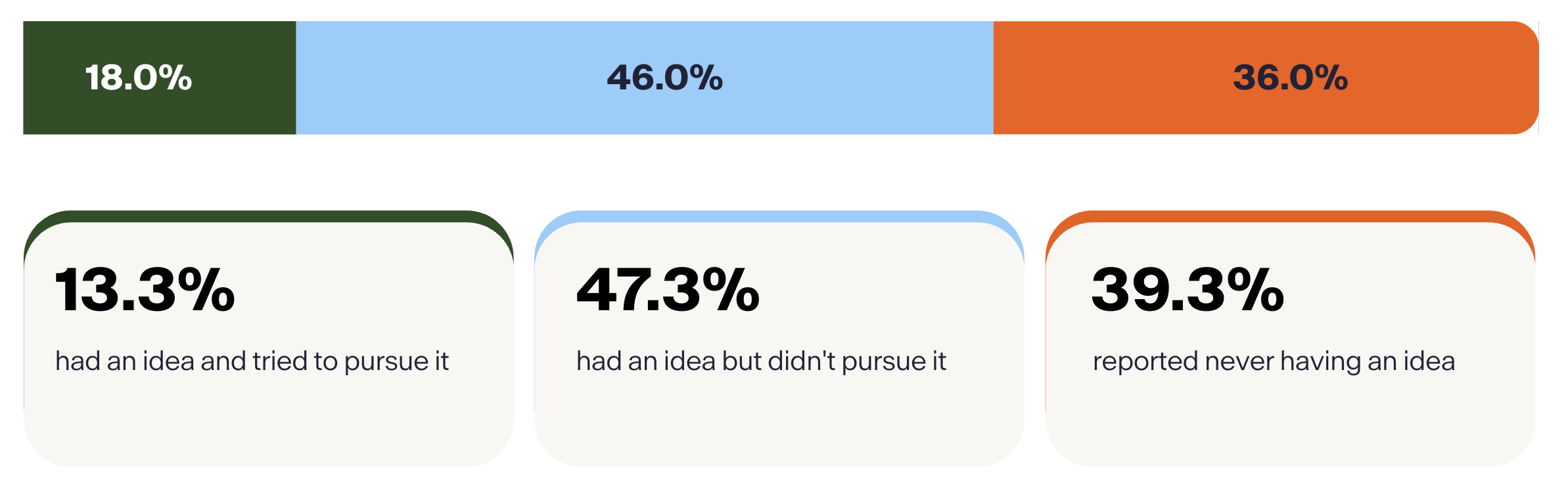
Among the educators who have had an idea, 78.0% never seriously pursued it. That is the widest distance between having a thought and doing something about it that this survey records, and it sets up everything that follows.
The same restlessness runs through how educators think about staying. Among those who have had an idea, 75.8% have seriously considered leaving education to chase an opportunity outside the system.
18.7% have already left or plan to. 57.1% weighed it and stayed. Only 24.2% never considered it. As in other places, the biggest group is made up of people who felt the pull and remained anyway.
Given five extra hours and the means to use them, San Antonio educators reach outward before they reach inward.
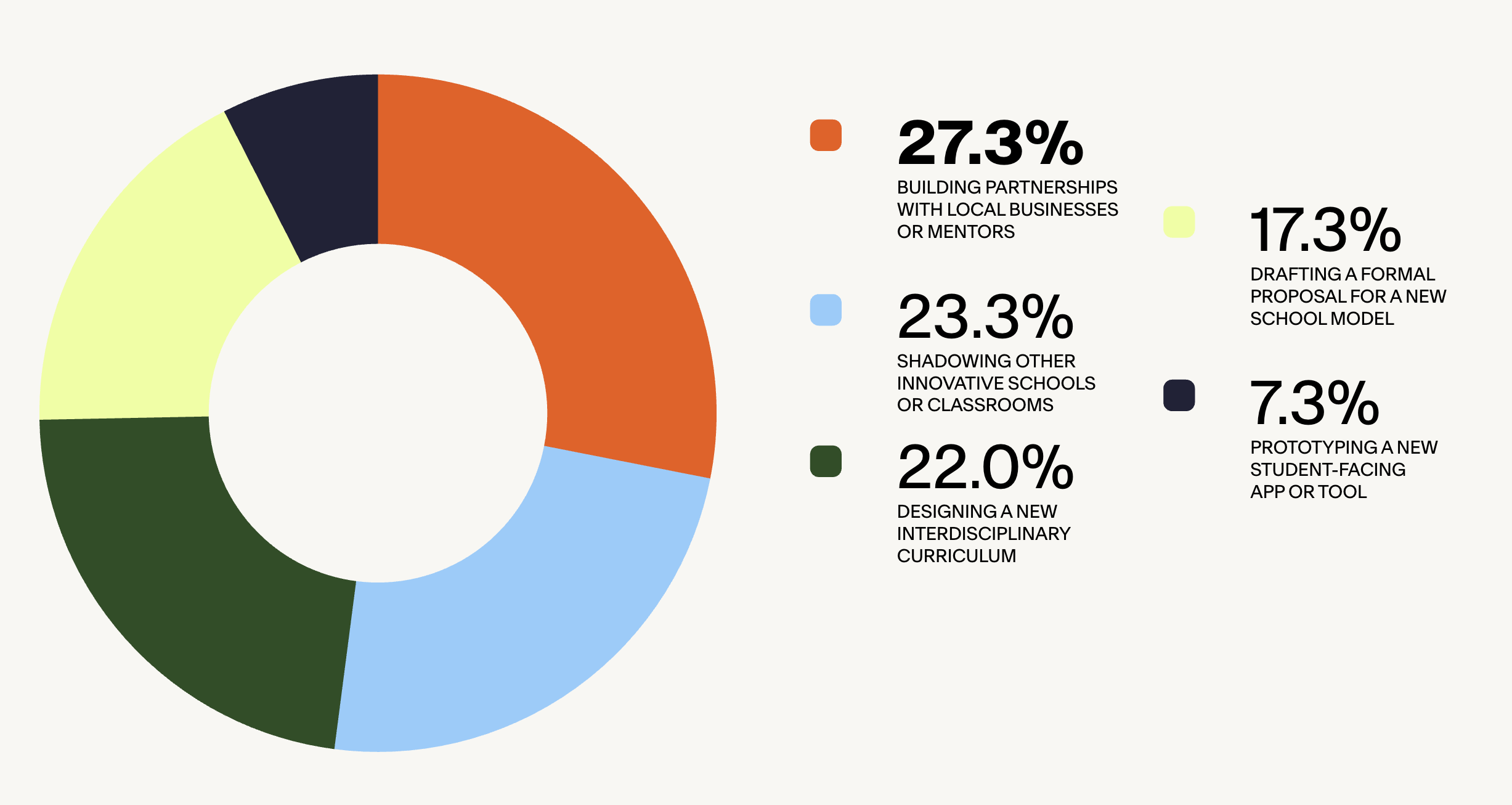
Partnerships top the list, and 50.7% combined would spend the time connecting with people and places beyond their own building rather than working alone.
The relatively high share who would draft a formal proposal for a new school model (17.3%) is its own signal. The appetite is not only to tinker but to build something structurally different, and to do it alongside others.
This Time, the Wall Really Is Money
Ask educators who shelved an idea why, and San Antonio gives an answer the other questions only hint at. The first obstacle is the bank balance, not the road map.

Money and missing pathways finish within three points of each other and together explain 76.0% of stalled ideas.
Fold in the educators who doubt anyone would fund the work, and 84.5% of the reasons are about money and pathways.
Fear of failure sits at just 4.2%. What stops a San Antonio educator is rarely nerve. It is the cost of acting.
What makes this city different is who is doing the naming. Financial risk is not a barrier read off the system from the outside. It is the educator's own verdict on whether they can afford to try.
The city-level picture confirms it. Asked for the single biggest barrier to launching new ideas locally:
- 29.3% funding - lack of local investors, grants, or philanthropists
- 22.0% time - workload leaves no margin for design
- 18.0% network - not knowing the right people
- 12.0% information - no clear "how-to" pathways for this city
- 10.0% safety - risk to job or reputation if a pilot fails
- 6.7% permission - too many approval layers
Capacity-related barriers (funding, time, network, and information) account for 81.3% of responses, the most resource-driven diagnosis in this series, while permission registers lowest of any barrier at 6.7%. Money leads at the kitchen table and at the city level both. In San Antonio the block is not primarily one of culture or red tape. It is one of resources.
And They Are Already Paying
Here the financial story turns on itself. The educators who say they cannot afford to gamble on an idea are, as a group, quietly bankrolling the basics.
- $0: 14.0%
- $1 to $100: 22.7%
- $101 to $300: 18.0%
- $301 to $500: 27.3%
- $501 to $1,000: 14.0%
- More than $1,000: 4.0%
86.0% spent their own money on tools, tech, or resources in the past year, and the largest single bracket is not the modest $101 to $300 band but $301 to $500. 45.3% spent more than $300 out of pocket, and 18.0% spent more than $500.
That is the paradox at the center of San Antonio's data. The same workforce that names financial risk as the reason it won't bet on a new idea is already spending real money, more of it than educators in other cities, to keep the classroom stocked. The shortage is genuine. A good deal of it is being absorbed personally, before any idea is ever on the table.
A System That Answers Upward, and to the State
Decision-making power, in educators' eyes, sits well above the building. Asked who most determines whether a new idea actually reaches students:
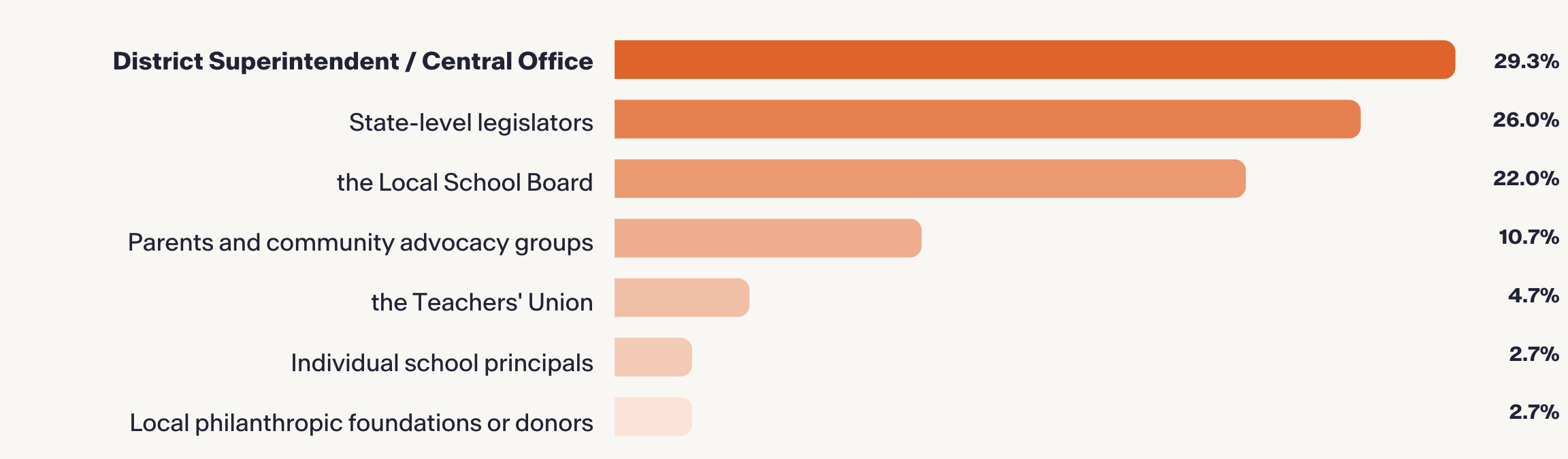
Official top-down channels hold 80.0% of perceived influence, which is familiar. What is not familiar is the runner-up. State-level legislators rank second at 26.0%, ahead of the local school board. In San Antonio the state, not only the district, is seen as deciding what makes it into a classroom, a sense of remote control that the other cities don't report to nearly this degree.
And the people in charge feel far away. Only 6.0% of educators describe local decision-makers as close enough to understand the daily struggle, the thinnest sense of nearness anywhere in this survey. 94.0% place them at a distance, with 57.3% calling them well-meaning but out of touch and 36.7% saying they live in a different reality entirely.
The phrase educators hear most reinforces the picture, and it carries a state accent.
- 46.0% "We don't have the budget/funding for that."
- 17.3% "We need to wait for District approval first."
- 16.7% "We've always done it this way."
- 14.0% "That's not going to be on the state test."
- 4.7% "That sounds too chaotic or unstructured."
Nearly everyone, around 99%, hears some version of no as the dominant message at work. The budget refusal leads, as it tends to. But the state test surfaces on its own at 14.0%, far above what a purely local story would predict, and squarely in line with the influence educators assign to the legislature.
Room to Try, but Only If the Scores Hold
If the test is the measure that matters, experimenting against it feels dangerous. That is more or less what educators report.
- 5.3% "No safety - mistakes are documented or punished"
- 36.0% "Very little - I only try things I know will work"
- 50.0% "Moderate - I can experiment if my scores stay high"
- 4.0% "High - my leadership encourages failing forward"
- 4.7% "Total freedom - innovation is expected, even if it fails"
91.3% of San Antonio educators operate with moderate or less room to fail, and only 8.7% work under leadership that actively encourages risk. The single most common answer, chosen by exactly half, is the conditional one: I can experiment, as long as my scores stay high. In a system where a state test looms over the work, that condition is doing a lot of quiet governing.
This caution is worth reading carefully, because it is not mainly about a hostile workplace. As the retention data will show, an unsupportive culture is a minor reason educators leave San Antonio. The pressure they describe is the pressure of performing against a number. Experimentation is allowed right up to the point where it might cost a result.
Alone in the Work, but Sure the City Has More
Even an educator who clears the cost and the scoreboard finds little community waiting. Asked to describe the innovation network around them:
- 36.0% "I didn't know there was a community for this in my city"
- 34.7% "I know a few other educators, but we are not organized"
- 18.0% "I feel like I am working in a total vacuum"
- 11.3% "I am part of a thriving, connected group of local changemakers"
88.7% are not part of any organized innovation community. More than a third did not know one could exist locally, and 18.0% describe their working life as a total vacuum, the loudest note of isolation in the survey. When there is no shared structure, people fall back on what they personally have.
- 31.3% my own personal network
- 28.7% a local university or research hub
- 26.7% nowhere - I don't believe a local place exists for grassroots education ideas
- 13.3% a specific local incubator or non-profit
The most common place to turn is the educator's own contacts, and more than a quarter believe there is simply nowhere to go. Industry is little help. 86.0% describe the connection between local industry and their school as transactional, invisible, or gatekept, with only 14.0% reporting real, ongoing partnership.
And yet educators can clearly see what the city is sitting on.
- 28.0% local universities and research institutions
- 26.7% community-based organizations and non-profits
- 14.7% a strong spirit of local resilience and grassroots activism
- 12.0% the city's arts, music, and cultural scene
- 11.3% local industry and corporate headquarters
54.7% point to universities and non-profits as the most under-leveraged assets, the very institutions that could knit a scattered workforce together.
Notably, 14.7% name grassroots resilience and activism, the strongest grassroots signal in any single line of this survey. The educators who feel most alone are also the ones most convinced the raw community spirit is there to be tapped.
Burnout, Restlessness, and the One Thing That Would Keep Them
The cost of all this lands first on the people. Asked which issue local leaders most avoid:
- 40.0% the mental health and burnout of innovative educators
- 24.0% the widening gap between high- and low-performing schools
- 20.0% student readiness for the local job market
- 9.3% the need for radically different school models
- 4.7% AI replacing traditional testing
Burnout leads by a wide margin. Job-market readiness sits unusually high in third at 20.0%, a workforce-pipeline worry running alongside the exhaustion.
Asked for one word to describe innovation in their city, most reach for a weary one, but not all.
- 36.0% stagnant - the system is actively resisting new ideas
- 25.3% exhausted - people want to innovate but have no energy left
- 16.7% restless - ready for change but stuck
- 15.3% emergent - small pockets of greatness are starting to connect
- 6.7% optimistic - we are the next great hub for education design
61.3% chose "stagnant" or "exhausted," and fewer than one in fifteen chose "optimistic." But "restless" lands third at 16.7%, a louder ready-but-stuck signal than the bleak words alone would suggest. There is energy banked under the fatigue.
That fatigue is what would push educators out. Asked the most likely reason they would leave within two years:
- 42.0% burnout - workload and red tape no longer sustainable
- 27.3% financial - need a higher salary
- 12.7% toxic culture - unsupportive leadership or environment
- 11.3% lack of autonomy - no freedom to innovate
- 5.3% pursuit of an idea - to launch outside the system
Burnout outruns the next reason by nearly fifteen points. Taken together, system-driven causes (burnout, toxic culture, and lost autonomy) account for 66.0% of likely departures, more than twice the share who would leave over pay. This is not a story about people fleeing a hostile building. It is a story about exhaustion and a lack of room to move.
Which is exactly what makes the final number matter. Asked how a guaranteed environment to freely pilot new ideas would change their plans:
- 38.7% "I would stay significantly longer than currently planned"
- 30.0% "I would stay a few years longer"
- 26.7% "It wouldn't change my current timeline"
- 4.7% "I am already planning to leave regardless"
68.7% would extend their time in education if given the freedom to pilot, and 38.7% would stay significantly longer, the largest single response to the question. A real chance to experiment pushes directly on the burnout and red tape that drive most of the attrition. The thing that would keep San Antonio's educators is, more or less, the thing they keep saying they want.
What This Means
San Antonio's educators are not waiting for inspiration. Three in five carry ideas, half would spend any spare time building outward, and most who have thought about leaving have chosen, for now, to stay. The obstacle is not courage and it is not imagination. It is, first and most concretely, money: the cost of taking a risk, named by the people who would have to bear it.
The hard irony is that the money is already moving. The same workforce that cannot afford to gamble on an idea is spending more of its own income to stock the classroom than educators anywhere else this survey has looked. The shortage is real, and a large part of it is being quietly covered by teachers before any new idea gets a hearing.
Around that financial core sit two reinforcing pressures. Authority feels distant and partly out of local hands, set as much in the state capitol as in the district office, and the work is judged against a test that makes experimentation feel costly. The result is the most cautious climate the survey records and a workforce that often feels alone in it.
But the same data names its own way forward. Educators point to universities, non-profits, and a deep well of grassroots resilience as the assets going unused, and more than two-thirds say a genuine chance to pilot would keep them in the profession longer. The restlessness is still there under the exhaustion. In San Antonio, the question is not whether the will exists. It is whether anyone will lower the cost of using it.
.png)
.png)
.png)
.png)
Be part of the community