Education Innovation Survey: Cleveland
What Cleveland Educators Say About Innovation, Burnout, and Where the Decisions Are Made
.png)
Almost every Cleveland educator with an idea has thought about leaving. Among those who have ever had one, 83.9% say they have seriously considered walking away from education to pursue something outside the system.
Almost all of them stayed.
A supermajority, 68.8%, weighed the exit and chose to remain. Only 15.1% have left or are planning to. What this survey captured is not a workforce heading for the door so much as one that keeps arriving at it, looking hard, and turning back.
At a Glance
- 62.0% of Cleveland educators have had an idea for a new school, program, tool, or app. 73.1% of them never seriously pursued it.
- Among those who have had an idea, 83.9% have considered leaving education, but 68.8% considered it and stayed.
- 50.0% say the phrase they hear most at work is "we don't have the budget for that."
- Funding (31.3%) and time (21.3%) are the two biggest barriers to launching new ideas. Capacity-related barriers total 80.0%.
- State legislators are seen as the most influential actor over whether an idea reaches students (25.3%), ranking above the superintendent and the school board.
- 48.0% say educator burnout is the issue local leaders most avoid, and "exhausted" is the word most often chosen for local innovation.
- 91.3% are not part of any organized innovation community, and 23.3% feel they work in a total vacuum.
- 65.3% would extend their time in education if given the freedom to pilot new ideas.
The Ideas Are There. Most Stay on the Shelf
Cleveland is not short on imagination. 62.0% of educators have had an idea for a new school, program, teaching tool, or app at some point in their career. What happens next is the problem.
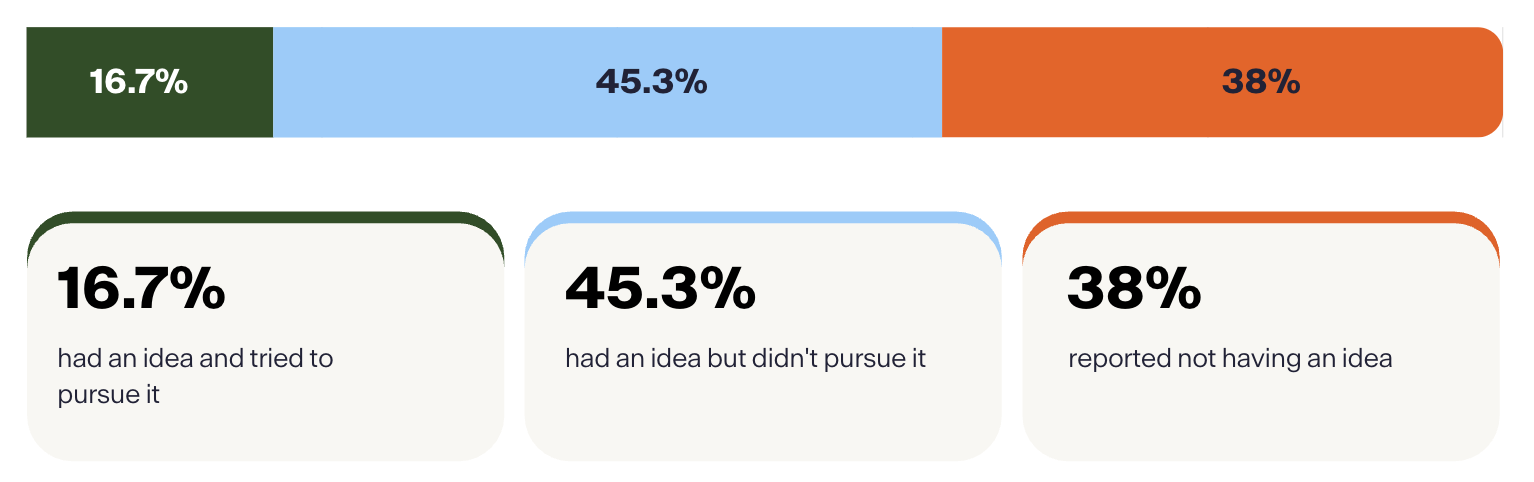
Among the educators who have had an idea, 73.1% never seriously pursued it.
The thought arrives, and then it sits.
The same restlessness shows up in how educators think about their own future, and this is where Cleveland reveals its particular character. Asked whether they have ever seriously considered leaving education for an opportunity outside the system:
- 68.8% considered it but decided to stay
- 16.1% have never considered it
- 15.1% have left or plan to leave
The middle group dwarfs the other two. This is a workforce that has done the math on leaving, in large numbers, and mostly elected to stay put. Loyalty is part of that, but so is fatigue and the gravity of a job that does not let go easily.
The later sections suggest it is closer to rootedness running low on fuel than to contentment.
When given five hypothetical hours and the resources to use them, educators lean outward rather than inward.
Building partnerships with local businesses or mentors (28.7%) edges out designing a new interdisciplinary curriculum (28.0%), with shadowing other innovative schools or classrooms close behind (20.0%). Drafting a formal proposal (12.0%) and prototyping a student-facing app (9.3%) trail. Put the two outward-facing options together and 48.7% would spend found time connecting with people and places beyond their own walls. The impulse is to reach out, not to build alone in a closed room.
What Stops an Idea, and the Barrier No One Names
Ask educators why their own idea stalled, and the answers are about means, not nerve. Among those who had an idea but never pursued it:
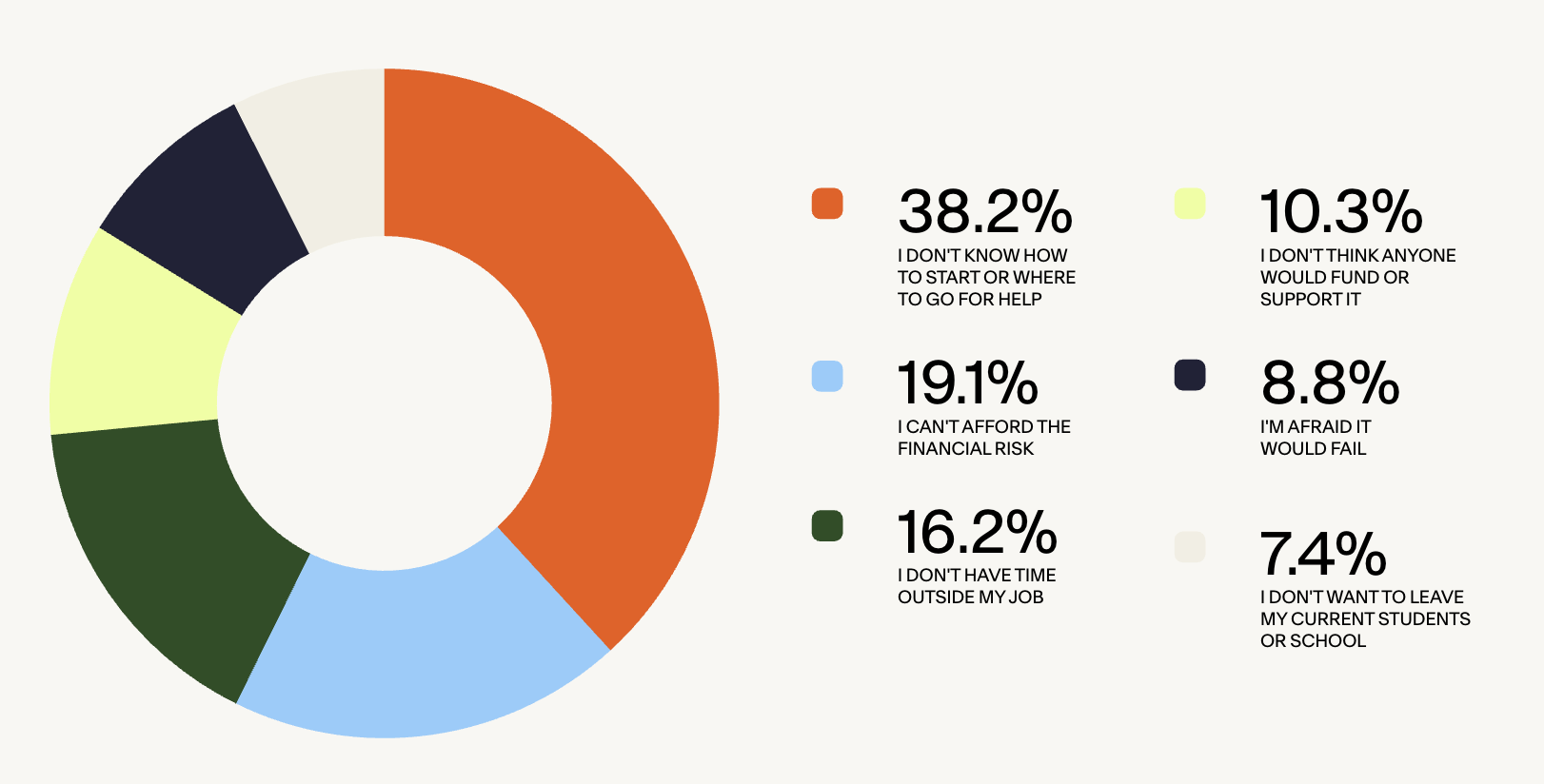
The three largest reasons, a missing map, financial risk, and no time, account for 73.5% of stalled ideas, and all three are about resources rather than courage. Fear of failure registers at 8.8%, a real but minor share.
Raise the question to the level of the city, and scarcity hardens into the headline. Asked for the single biggest barrier to launching new educational ideas locally:
- 31.3% funding - lack of local investors, grants, or philanthropists
- 21.3% time - workload leaves no margin for design
- 14.0% network - not knowing the right people
- 13.3% information - no clear "how-to" pathways for this city
- 8.7% permission - too many approval layers
- 8.0% safety - risk to job or reputation if a pilot fails
Funding and time alone make up 52.7% of responses, and the four capacity barriers together reach 80.0%.
Cleveland names its block plainly: not enough money, not enough hours.
What educators almost never name is fear. The safety barrier sits near the bottom at 8.0%, and the personal fear of failure at 8.8%. And yet the lived experience of experimenting tells a darker story than the stated barriers do. Asked how much psychological safety they have to fail while trying a new method:
- 9.3% "No safety - mistakes are documented or punished"
- 36.7% "Very little - I only try things I know will work"
- 42.0% "Moderate - I can experiment if my scores stay high"
- 9.3% "High - my leadership encourages failing forward"
- 2.7% "Total freedom - innovation is expected, even if it fails"
88.0% of Cleveland educators operate with moderate or less room to fail, and 46.0% have very little or none, including the 36.7% who say they only attempt what they already know will succeed. Only one in eight works under leadership that encourages risk. The clincher is what they would change if they could change one thing: asked which regional barrier they would dismantle tomorrow, 35.3% chose the compliance-first mindset of local evaluations, by far the largest answer, with the rigid minutes-per-subject requirements next at 18.7%.
So the caution is real and, when asked about it directly, top of mind. It simply is not the word educators reach for when asked what stopped them. They reach for money and time, because those feel concrete and external. The evaluation culture that quietly narrows what they will try goes unnamed in the barrier question and surfaces only when the survey asks about it head-on.
The Power Sits in Columbus
In every conversation about whose permission an idea needs, one finding sets Cleveland apart. Asked which local entity has the most influence over whether a new idea actually reaches students, educators look past their own district:

The statehouse outranks the superintendent's office. That is unusual, and it is internally consistent: the barrier educators name most is funding, and the body that sets the school funding formula is the legislature, not the district. In their open-ended answers, funding surfaced again and again, with several educators pointing specifically at how schools are financed at the state level. The resource they most lack is governed by the actor they feel least able to reach.
And reach is exactly the problem. Only 10.7% of educators describe local decision-makers as close enough to understand the daily struggle. 89.3% place them at a distance, split between 57.3% who call them "distanced but well-meaning" and 32.0% who call them "disconnected, living in a different reality." If the most powerful actor in the system is the state legislature, then the distance educators feel is not a short walk to the central office. It is a drive to the capital.
That remoteness arrives daily as a single sentence. Asked which phrase they hear most often in their school culture, 50.0% chose "We don't have the budget or funding for that," with "We've always done it this way" a distant second at 19.3%. Half the workforce hears a money refusal more than any other message, and the second most common message is simple inertia. Roughly 96% name some version of no as the dominant phrase in their building. The answer comes back before the idea is fully out.
The Cost Reads as Exhaustion
Other cities in this work describe their climate as stuck. Cleveland describes itself as tired. Asked which education issue local leaders are most avoiding, the answer is decisive:
- 48.0% the mental health and burnout of innovative educators
- 18.0% the widening gap between high- and low-performing schools
- 13.3% AI replacing traditional testing
- 10.7% student readiness for the local job market
- 6.7% the need for radically different school models
Nearly half name burnout, more than the next two answers combined. The same exhaustion drives the exit. Asked the most likely reason they would leave their school within two years:
- 44.7% burnout - workload and red tape no longer sustainable
- 28.0% financial - need a higher salary
- 13.3% toxic culture - unsupportive leadership or environment
- 7.3% lack of autonomy - no freedom to innovate
- 3.3% pursuit of an idea - to launch outside the system
System-driven reasons, burnout plus lost autonomy plus toxic culture, account for 65.3% of likely departures, more than double the share who would leave over pay. What separates Cleveland from a city like Chicago is the mix: here toxic culture is a relatively minor factor at 13.3%, while burnout stands almost alone at the top. The problem is less a hostile environment than an emptied tank.
That word choice repeats when educators describe innovation in their city in a single word. "Exhausted" is the most common answer at 31.3%, edging out "stagnant" at 28.0%, with only 6.7% choosing "optimistic." Cleveland is the rare place where people are more likely to say they are out of energy than to say the system is fighting them. The two readings are related, but the emphasis matters. Stagnation is something done to you. Exhaustion is something you feel.
Meanwhile, educators continue to quietly cover the gaps themselves. 81.3% spent their own money on tools, technology, or resources in the past year, and 30.0% spent more than $300 out of pocket. The budget that is missing in the daily refrain is being topped up, in part, from teachers' own pockets.
A Workforce Largely on Its Own
If an idea survives the funding wall and the exhaustion, it still has nowhere obvious to go. Cleveland's educators are the most disconnected from one another of any group surveyed. Asked to describe the innovation community around them:
- 34.7% "I didn't know there was a community for this in my city"
- 33.3% "I know a few other educators, but we are not organized"
- 23.3% "I feel like I am working in a total vacuum"
- 8.7% "I am part of a thriving, connected group of local changemakers"
91.3% are not part of any organized innovation community, and nearly a quarter describe outright isolation, working in a total vacuum. Fewer than one in ten belongs to anything that could be called a connected group. With no shared structure, support becomes a private matter. Asked where they would actually go for collaborators, 34.7% said their own personal network and 24.7% said nowhere at all, believing no local place exists for grassroots education ideas.
Industry offers a thin bridge, though a slightly sturdier one than in peer cities. The connection between local industry and schools is described as transactional by 37.3%, invisible by 26.7%, and gatekept by 18.0%, leaving 82.0% without a real partnership and 18.0% reporting genuine, ongoing collaboration.
The frustration is that the raw material for a network is visibly present. Asked to name the city's most under-leveraged asset, educators point to institutions that could anchor one:
- 25.3% local universities and research institutions
- 22.7% community-based organizations and non-profits
- 22.0% the city's arts, music, and cultural scene
- 11.3% local industry and corporate headquarters
- 9.3% a strong spirit of local resilience and grassroots activism
Universities and non-profits together draw 48.0%, and Cleveland adds a distinctive third pillar: its arts and cultural scene, named by 22.0%, nearly level with the non-profits. The connective tissue exists in the city. It has simply never been wired together for educators.
What This Means
Cleveland's educators are not waiting for inspiration and they are not, for the most part, walking out. They have ideas, they have mostly considered leaving and chosen to stay, and they lean outward when they imagine doing more. The forces working against them are concrete: a chronic shortage of money and time, a workplace where the most common sentence is a budget refusal, and an evaluation culture that narrows what they will risk even though they rarely name it as the reason.
What makes the city's situation feel intractable is where the levers are. The barrier educators cite most is funding, and the actor they see as most powerful is the state legislature, the part of the system that sits farthest from any classroom. The resource is real, the authority over it is real, and the distance between the two is the gap this report keeps returning to. The cost of that gap is showing up as exhaustion, as the most isolated educator workforce in this series, and as a steady out-of-pocket subsidy from teachers themselves.
The same data carries the opening. Educators name universities, non-profits, and a strong arts scene as the city's most wasted assets, the exact pieces that could be assembled into the connective structure they currently lack. And 65.3% say a genuine chance to pilot new ideas would keep them in education longer, with the largest groups willing to stay significantly or several years past their current plans. That is a meaningful lever, even if a third say it would not move their timeline, because it lands on the exhaustion and red tape that drive most of the attrition.
A workforce this tempted to leave and this determined to stay is telling you something. It is still here. The question Cleveland's data poses to its leaders, and to the statehouse that holds so much of the power, is how much longer it intends to make staying this hard.
.png)
.png)
.png)
.png)
Be part of the community